History and Religious Significance of Gopal Mandir in Ujjain: Discover Its Silver Doors and the Sacred Hari-Har Milan Tradition
Explore the history of Gopal Mandir in Ujjain, its construction by Maharani Bayajibai Shinde, beautiful Maratha architecture, silver-plated doors, worship of Lord Krishna, and the sacred Hari-Har Milan ceremony celebrated on Vaikuntha Chaturdashi.
History and Religious Significance of Gopal Mandir in Ujjain: Discover Its Silver Doors and the Sacred Hari-Har Milan Tradition
Ujjain, one of the most sacred cities in Madhya Pradesh, is widely known as the city of Lord Mahakaleshwar. Along with its famous Shiva temples, the city is also home to several important religious places associated with Lord Vishnu and Lord Krishna. One such prominent shrine is Shri Gopal Mandir, dedicated to Lord Krishna.
Situated in the heart of Ujjain's busy market area, Gopal Mandir is admired for its beautiful architecture, marble-decorated sanctum and silver-plated doors. However, one of its most distinctive religious traditions is the sacred Hari-Har Milan ceremony celebrated on Vaikuntha Chaturdashi, when the procession of Lord Mahakaleshwar visits the temple.
Let us explore the history, architecture and religious significance of this famous temple.
1. History of Gopal Mandir
Gopal Mandir was constructed during the 19th century under the Scindia rule of Ujjain. The temple is credited to Maharani Bayajibai Shinde, the wife of Maharaja Daulat Rao Scindia.
Maharani Bayajibai was known for her religious devotion and contribution to temple construction and preservation. Gopal Mandir stands as a beautiful example of her faith and patronage.
The temple reflects the Maratha style of architecture, with its impressive structure, decorative elements and elegant design.
2. A Temple Dedicated to Lord Krishna
Gopal Mandir is dedicated to Lord Krishna, worshipped here in his Gopal form. The word Gopal refers to Krishna as the protector and caretaker of cows.
The main sanctum houses an idol of Lord Gopal Krishna made of black stone, accompanied by the idol of Radhika. Idols of Goddess Rukmini and Lord Shiva with Goddess Parvati are also present in the temple.
For devotees of Lord Krishna, this temple is an important place of worship. Visitors offer prayers for peace, happiness, prosperity and well-being.
3. Silver-Plated Doors: A Major Attraction
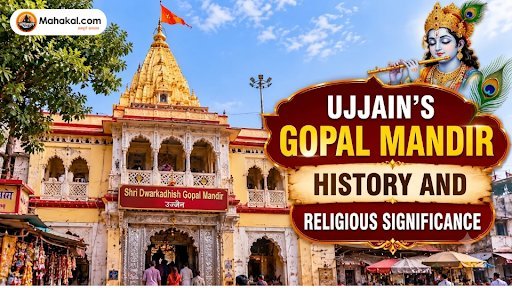
One of the most remarkable features of Gopal Mandir is its silver-plated sanctum doors.
The intricate craftsmanship and beautiful silver finish add to the grandeur of the temple. The sanctum is decorated with marble, while the interior reflects the artistic traditions of the period.
A popular local tradition connects these silver doors with the Somnath Temple and says that they were brought back by the Marathas. However, this account should be understood as a popular temple legend rather than a fully established historical fact.
4. Hari-Har Milan: A Unique Religious Tradition
The most distinctive religious event associated with Gopal Mandir is Hari-Har Milan, celebrated on Vaikuntha Chaturdashi.
In Hindu tradition, Hari refers to Lord Vishnu, while Har refers to Lord Shiva. During this special occasion, the ceremonial procession of Lord Mahakaleshwar arrives at Gopal Mandir at night.
A symbolic meeting takes place between Lord Shiva and Lord Gopal Krishna, representing the divine forms of Shiva and Vishnu.
This tradition conveys a message of harmony between Shaivism and Vaishnavism. Devotees gather in large numbers to witness this sacred occasion and participate in the celebrations.
5. Spiritual Meaning of Hari-Har Milan
Hari-Har Milan is more than a religious ceremony. It represents an important spiritual message of unity within Hindu traditions.
Lord Shiva and Lord Vishnu are worshipped in different forms, but both hold an equally respected place in Hindu philosophy and devotion.
The tradition reminds devotees that different forms of the Divine should not be seen as rivals. Faith, love, devotion and respect are the foundations of spiritual life.
6. Special Celebrations During Janmashtami
Janmashtami, the birth anniversary of Lord Krishna, is celebrated with great devotion at Gopal Mandir.
During this festival, the temple is beautifully decorated and special adornments are offered to Lord Gopal Krishna. Devotees participate in prayers, devotional singing and religious ceremonies.
The atmosphere becomes especially festive as devotees gather to celebrate the divine birth of Lord Krishna.
7. Architecture of Gopal Mandir
Gopal Mandir is a fine example of Maratha architecture. Its marble work, decorative structure and elegant design make it an important heritage site in Ujjain.
The sanctum is beautifully decorated with marble, while the silver-plated doors remain one of its most recognisable features. The spacious temple complex also adds to its architectural appeal.
The temple reflects not only religious devotion but also the artistic and cultural traditions of its period.
8. Location of Gopal Mandir in Ujjain
Gopal Mandir is situated in the central market area of Ujjain, in the historic part of the city.
Devotees visiting the Mahakaleshwar Jyotirlinga can also include Gopal Mandir in their religious itinerary. Its central location makes it convenient to reach through local transport.
Visitors can reach the temple from Ujjain Railway Station and other major parts of the city using local transportation.
9. Religious Significance of Visiting Gopal Mandir
For devotees, visiting Gopal Mandir is an expression of faith and devotion towards Lord Krishna. People offer prayers for happiness, peace, prosperity and the well-being of their families.
The temple becomes particularly important during Janmashtami and Vaikuntha Chaturdashi, when special religious celebrations take place.
Those exploring the sacred city of Ujjain can make Gopal Mandir an important stop along with the famous Mahakaleshwar Temple.
Conclusion
Gopal Mandir is not just a beautiful temple dedicated to Lord Krishna; it is also an important part of Ujjain's historical, cultural and spiritual heritage.
Built under the patronage of Maharani Bayajibai Shinde, the temple is known for its Maratha architecture, silver-plated doors and the beautiful idol of Lord Gopal Krishna.
Its most remarkable tradition, Hari-Har Milan, symbolises harmony between Lord Shiva and Lord Vishnu and conveys the message of unity within Sanatan Dharma.
For anyone visiting Ujjain, a visit to Gopal Mandir offers a meaningful glimpse into the city's rich spiritual traditions and religious heritage.
What's Your Reaction?