How Did River Ganga Descend on Earth? Know About Bhagirath's Mythology
Discover the divine story of how River Ganga descended from heaven to earth through the extraordinary penance of King Bhagirath. Learn about Lord Shiva, Sage Kapila, King Sagara, and the spiritual significance of Ganga in Hindu mythology. Explore the complete mythology, symbolism, timeline, and religious importance of Ganga Avataran and Ganga Dashami through the Mahakal.com blog.
How Did River Ganga Descend on Earth? Know About Bhagirath's Mythology
The story of how the sacred river Ganga descended from the heavens to earth is one of the most profound, moving, and spiritually significant tales in all of Hindu mythology. It is a story of unwavering devotion, supreme penance, divine compassion, and the power of one man's will to change the fate of thousands.
At the heart of this extraordinary narrative stands King Bhagirath — whose name itself has become a synonym for impossible effort and perseverance in the Indian cultural lexicon.
Experience Sanatan Dharma at Your Space, Download the Mahakal.com App Today.
What does "Bhagirath Prayaas" mean?
In Indian culture, the phrase Bhagirath Prayaas (Bhagirath's effort) is used to describe an extraordinarily difficult, seemingly impossible task accomplished through sheer willpower and determination — inspired directly by King Bhagirath's legendary penance.
Scriptural Sources
The story of Ganga's descent is narrated in multiple ancient Hindu scriptures. The most detailed account appears in the Bala Kanda of Valmiki's Ramayana, where sage Vishwamitra narrates the story to young Ram and Lakshman.
It also appears in the Mahabharata's Anushasana Parva and the Vishnu Purana, with some variations in detail across texts.
- Valmiki Ramayana — Bala Kanda
- Mahabharata — Anushasana Parva
- Vishnu Purana
- Bhagavata Purana
- Devi Bhagavata Purana
Key Characters in the Story
King Bhagirath
The determined king whose penance brought Ganga to earth.
Goddess Ganga
The divine river, daughter of Himavat, flowing from Vishnu's feet.
Lord Shiva
Agreed to bear Ganga's force in his matted locks (jata).
Lord Brahma
Blessed Bhagirath and directed Ganga to flow to earth.
Sage Kapila
Whose fury reduced 60,000 sons of Sagara to ashes.
King Sagara
Bhagirath's ancestor whose 60,000 sons needed liberation.
The Complete Story of Ganga's Descent
Part 1 — King Sagara and his 60,000 sons
The story begins with the mighty King Sagara of the Ikshvaku dynasty — an ancestor of Lord Ram. King Sagara had two wives: Keshini, who gave birth to one son named Asamanjas, and Sumati, who gave birth to sixty thousand sons.
King Sagara decided to perform the Ashwamedha Yagya (the horse sacrifice) — a grand ritual that would establish his supremacy over all kings.
As part of this ritual, a sacred horse was released to roam freely across the land. Wherever it went, no king could stop it — to do so was a declaration of war.
However, Lord Indra, the king of the gods, became worried about Sagara's growing power and stole the horse. He hid it near the hermitage of the great sage Kapila Muni, who was deep in meditation.
Sagara's sixty thousand sons set out in search of the horse. After a long and fruitless search across the earth, they dug deep into the ground, literally excavating the entire planet in their quest — which is why the ocean is called Sagara in Sanskrit, said to have been dug out by these sons.
Finally, they found the horse near Sage Kapila's hermitage.
Why is the ocean called "Sagara"?
According to the Ramayana, the sixty thousand sons of King Sagara dug so extensively into the earth in search of the sacrificial horse that their excavation created the vast ocean.
This is the mythological origin of the ocean being named Sagara — after their father, King Sagara.
Part 2 — The curse of Sage Kapila
When the sixty thousand sons of Sagara reached Sage Kapila's hermitage and saw the horse tied nearby, they mistakenly assumed the sage had stolen it.
In their arrogance, they raised weapons against the deeply meditating sage. Their disturbance broke Kapila's deep trance.
Kapila opened his eyes — and the fire of his tremendous spiritual power (tapas-shakti) blazed forth instantly.
In a single moment, all sixty thousand sons of King Sagara were reduced to ashes.
Their souls were trapped in a state of unrest — unable to find peace, unable to attain moksha — because they had died without proper last rites and had committed a grave sin against a sage.
Part 3 — Generations of failed attempts
The news reached King Sagara, who was grief-stricken. He sent his grandson Ansuman to recover the horse and find out what happened to his sons.
Ansuman reached Sage Kapila with great humility, recovered the horse, and asked how his uncles could attain liberation.
Kapila told him that only the sacred waters of the celestial river Ganga could wash away their sins and grant them moksha.
Ansuman spent his entire life trying to bring Ganga down from the heavens — but could not succeed.
His son Dilipa tried with equal dedication, but he too could not accomplish this impossible task.
The souls of the sixty thousand sons continued to wander without peace.
Part 4 — Bhagirath's extraordinary penance
Then came King Bhagirath, the son of Dilipa.
Determined to succeed where his ancestors had failed, Bhagirath renounced his kingdom, left all royal comforts behind, and went to the Himalayas to perform intense penance.
His tapasya was extraordinary and unrelenting :
- He stood on one leg for thousands of years, arms raised toward the sky
- He ate only fallen leaves and drank only water
- He withstood extreme heat, cold, wind, and rain without shelter
- He maintained absolute celibacy, truthfulness, and mental discipline
Pleased by this supreme austerity, Lord Brahma appeared before Bhagirath and granted him a boon.
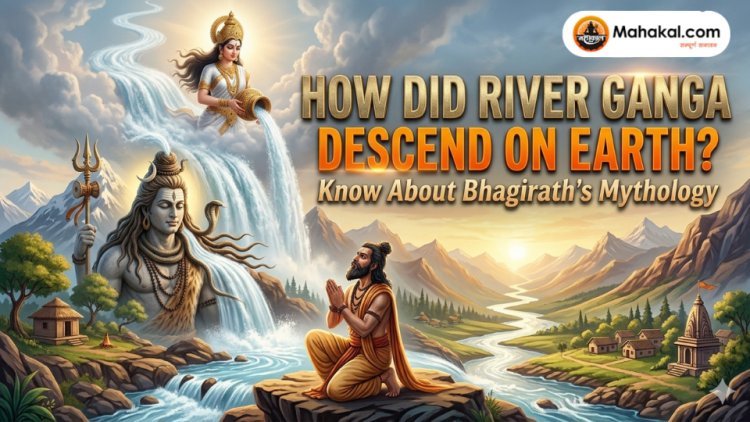
Bhagirath asked for Ganga to be released from the heavens to earth so she could purify the ashes of his ancestors.
Brahma agreed — but warned Bhagirath that the force of Ganga's descent from the heavens would be so immense that the earth could not bear it.
Only Lord Shiva could contain her in his matted locks (jata) and release her gently.
Part 5 — Shiva agrees to bear Ganga
Bhagirath then performed another intense penance — this time to please Lord Shiva.
For a year he stood on one toe, arms raised, meditating upon Shiva.
Moved by his devotion, Shiva appeared and agreed to receive Ganga in his matted locks.
When Ganga descended from the heavens, she came with tremendous force and arrogance — confident that no one could bear her might.
But Shiva simply received her in the dense, vast labyrinth of his matted hair.
Ganga swirled and churned within Shiva's locks for ages, unable to find her way out.
Finally, Bhagirath prayed again, and Shiva gently released Ganga from his hair — flowing peacefully onto the earth as the holy river we know today.
Why does Ganga flow through Shiva's hair?
This is the mythological explanation for why Shiva is depicted in iconography with the crescent moon and the river Ganga flowing from his matted locks.
Ganga's descent through Shiva's jata is said to have transformed her from a proud celestial river into a humble, life-giving force on earth.
Part 6 — Ganga flows to the ocean and liberates the ancestors
Once released from Shiva's locks, Ganga followed King Bhagirath as he guided her in his chariot across the land.
However, along the way, Ganga's waters accidentally flooded the hermitage of Sage Jahnu, who was also deep in penance.
Angered by the disturbance, Jahnu drank up all of Ganga's waters in one sip.
Bhagirath prayed to the sage with great humility.
Pleased, Jahnu released the river from his ear — and from that day, Ganga is also called Jahnavi (daughter of Jahnu).
Finally, Bhagirath guided Ganga all the way to the underworld (Patala), where the ashes of the sixty thousand sons of Sagara lay.
The moment Ganga's sacred waters touched the ashes, the souls of all sixty thousand sons were purified and liberated — they attained moksha and ascended to the heavens.
Bhagirath's penance of multiple lifetimes had finally borne fruit.
The Journey — A Timeline
King Sagara performs Ashwamedha Yagya
Indra steals the sacred horse and hides it near Sage Kapila's hermitage to disrupt the ritual.
60,000 sons search the earth
They dig deep, creating the ocean (Sagara), and find the horse near Kapila Muni's ashram.
Kapila's curse reduces them to ashes
Their disrespect toward the meditating sage results in instant destruction by the fire of his tapas.
Ansuman learns the only path to salvation
Sage Kapila reveals that only Ganga's waters can grant moksha to the 60,000 souls.
Ansuman and Dilipa fail after lifelong penance
Two generations devote their lives to bringing Ganga down but cannot succeed.
Bhagirath's supreme tapasya pleases Brahma
Brahma grants the boon but warns that only Shiva can bear Ganga's force.
Shiva receives Ganga in his matted locks
After another penance, Bhagirath convinces Shiva, who traps Ganga's force in his jata.
Ganga reaches earth — the Jahnavi episode
Sage Jahnu swallows Ganga; Bhagirath's prayer leads to her release as "Jahnavi."
Liberation of 60,000 souls
Ganga's waters touch the ashes in Patala — all souls attain moksha. Bhagirath's mission is complete.
Why is Ganga considered the most sacred river?
Born from Vishnu's feet
Ganga is said to have originated at Lord Vishnu's feet (Vishnupadi) — hence considered supremely divine.
Purified by Shiva's jata
Her passage through Shiva's matted locks gave her the power to purify all sins.
Liberator of souls
Her touch liberated 60,000 souls at once — earning her the title Moksha-dayini.
Symbol of karma purification
A dip in the Ganga is believed to wash away the sins of many births.
Tri-Patha-Gaa
She flows in three realms — heaven (Mandakini), earth (Ganga), and the underworld (Bhogavati).
Central to Hindu rituals
Ganga jal (holy water) is used in every major Hindu sacrament — birth, marriage, and death.
❓ Frequently Asked Questions
How did Ganga descend from heaven to earth?
Bhagirath performed intense penance to please Brahma and Shiva. Shiva received Ganga in his matted locks and released her gently onto earth.
Who is Bhagirath and why is he famous?
Bhagirath was the king whose extraordinary penance brought Ganga from heaven to earth for the salvation of his ancestors.
Why did the sons of King Sagara turn to ashes?
They disturbed Sage Kapila during deep meditation and were burned by the power of his spiritual energy.
Why is Ganga also called Jahnavi?
Because Sage Jahnu released her from his ear after swallowing her waters.
Why did Shiva receive Ganga in his hair?
The force of Ganga's descent was too powerful for earth to bear, so Shiva controlled her flow through his jata.
What is the spiritual significance of Ganga Dashami?
Ganga Dashami celebrates the sacred descent of Goddess Ganga onto earth and is considered highly auspicious for spiritual purification.
- How did River Ganga descend on earth in Hindu mythology
- Bhagirath and Ganga mythology story 2026
- Spiritual significance of River Ganga in 2026
- Lord Shiva and Ganga Avataran story
- Ganga Dashami 2026 and Bhagirath penance
- Why River Ganga is considered sacred in Sanatan Dharma
What's Your Reaction?