Why Did Bhagwan Parshuram Wipe Out Kshatriyas 21 Times ? The Untold Truth Revealed
Discover the real reason why Bhagwan Parshuram eliminated Kshatriyas 21 times. Explore the untold truth behind Sahastrarjun’s tyranny, Jamadagni’s death, and the deeper meaning of Dharma, justice, and cosmic balance in Sanatan tradition. Read complete details on Mahakal.com.
Why Did Bhagwan Parshuram Wipe Out Kshatriyas 21 Times? The Untold Truth Revealed
Introduction
Among all the avatars of Lord Vishnu, Bhagwan Parshuram stands apart as the most intense and uncompromising protector of Dharma. Revered as one of the eight Chiranjeevis, his presence spans across both the Ramayana and the Mahabharata, making him a timeless figure in Sanatan tradition.
Yet, one question continues to spark curiosity and debate :
Why did Bhagwan Parshuram annihilate the Kshatriyas 21 times?
This is not merely a tale of anger or revenge, but a profound narrative rooted in justice, cosmic balance, and the consequences of unchecked power.
The Identity of Parshuram – More Than a Warrior
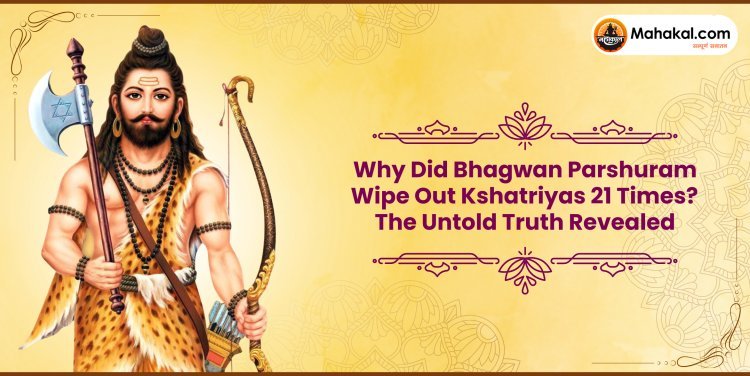
Born as the son of sage Jamadagni and Mata Renuka, Parshuram was originally named “Ram.” His transformation began when Lord Shiva, pleased by his devotion, bestowed upon him the divine weapon Parashu (axe), along with unmatched martial knowledge.
He became a rare embodiment of both Brahmin wisdom and Kshatriya valor — a combination meant to restore balance when rulers themselves turned unjust. His anger was not impulsive, but a response to systemic Adharma.
Sahastrarjun – The Rise of Tyranny
The root cause of this massive destruction lies in the story of Sahastrarjun (Kartavirya Arjuna), a king blessed with extraordinary powers by Lord Dattatreya. With thousands of arms and unmatched strength, he became nearly invincible.
However, power without restraint led to tyranny :
- Sacred ashrams were destroyed
- Sages and Brahmins were humiliated
- Innocent lives were taken
- Women and societal values were dishonored
- Scriptures and Dharma were openly rejected
His rule symbolized the peak of Adharma, where authority turned into oppression.
The Sacred Ashram Incident – A Turning Point
When Sahastrarjun visited the ashram of sage Jamadagni, he was welcomed with humility and respect. The sage possessed Kamdhenu, a divine cow capable of fulfilling all needs.
Blinded by greed, Sahastrarjun forcefully tried to seize Kamdhenu and devastated the ashram.
Upon returning, Parshuram witnessed this destruction and, in righteous anger, killed Sahastrarjun. But this act triggered a chain of events far more tragic.
The Brutal Murder of Jamadagni – The Moment of Vow
In retaliation, Sahastrarjun’s sons attacked the ashram while Parshuram was away. They mercilessly killed sage Jamadagni during his meditation and left his body mutilated.
When Parshuram returned, he saw :
- His father’s severed body
- His grieving mother Renuka
- Twenty-one deep wounds inflicted on Jamadagni
This was not just a personal loss — it symbolized the complete breakdown of Dharma.
At that moment, Parshuram took a fierce vow :
He would rid the Earth of Kshatriyas 21 times, each cycle representing one wound on his father’s body.
The 21 Campaigns – Revenge or Restoration of Dharma?
While it may appear as an act of vengeance, scriptures reveal a deeper perspective. During that era :
- Many Kshatriya rulers had abandoned righteousness
- Governance had turned exploitative
- Social order was collapsing
Parshuram’s campaigns were not indiscriminate killings, but a systematic cleansing of corrupt power structures.
He destroyed those who misused authority and restored balance, ensuring that Dharma once again guided leadership.
Philosophical and Spiritual Interpretation
The story of Parshuram carries timeless lessons :
- Ego and arrogance inevitably lead to downfall
- Power must always be aligned with righteousness
- Divine justice may appear harsh but serves a higher purpose
- Dharma is above all social roles and hierarchies
Parshuram symbolizes the force that emerges when injustice crosses all limits — a reminder that cosmic balance will always be restored.
Conclusion
Bhagwan Parshuram’s act of eliminating Kshatriyas 21 times was not merely a reaction of anger, but a decisive intervention to restore Dharma in a collapsing world.
His story teaches that when power becomes oppressive and righteousness fades, divine forces rise to correct the imbalance.
Even today, Parshuram stands as a symbol of discipline, justice, and unwavering commitment to truth, reminding humanity that Dharma must always prevail.
- How many times did Parshuram vanished from Kshatriya?
- Why did Parshuram stop teaching Kshatriya?
-
Which Kshatriya defeated Parshuram?
- Why Parshuram killed Kshatriyas 21 times
- avatars of Lord Vishnu
- Brutal Murder of Jamadagni
What's Your Reaction?