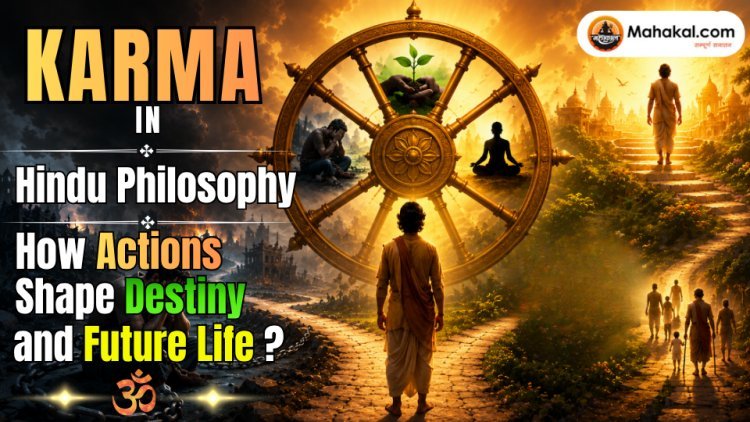
Karma in Hindu Philosophy : How Actions Shape Destiny and Future Life
Explore the deep meaning of Karma in Hindu Philosophy and understand how actions, thoughts, and intentions shape destiny and future life. Learn about the connection between Karma, rebirth, Dharma, and Moksha through the teachings of Sanatan Dharma, Bhagavad Gita, and ancient Hindu scriptures. Discover the types of Karma, their impact on daily life, and how conscious living can transform spiritual growth and future experiences.
Karma in Hindu Philosophy : How Actions Shape Destiny and Future Life
Introduction
In the vast spiritual wisdom of Sanatan Dharma, few concepts are as profound and transformative as Karma. More than just a belief in “cause and effect,” Karma is a divine law that governs human actions, thoughts, intentions, and their consequences across lifetimes. Hindu philosophy teaches that every action leaves an imprint on the soul, shaping not only present circumstances but also future destiny and rebirth.
The idea of Karma is deeply rooted in sacred scriptures like the Bhagavad Gita, Upanishads, Vedas, and various Puranas. It explains why individuals experience different situations in life, why some actions bring peace while others bring suffering, and how spiritual liberation can ultimately free the soul from the cycle of birth and death.
Understanding Karma is not merely philosophical ; it is a guide for living consciously, ethically, and spiritually.
What Is Karma in Hindu Philosophy?
The word “Karma” comes from the Sanskrit root Kri, meaning “to act.” In Hindu philosophy, Karma refers to every action performed by an individual — physical, mental, emotional, or verbal. These actions create subtle energies that eventually return to the doer in some form.
Karma is not punishment or reward imposed by an external force. It is considered a universal cosmic law operating with complete balance and justice. Just as a seed eventually grows into a tree, every action eventually produces results.
Hindu teachings emphasize that :
- Good actions create positive Karma.
- Harmful actions create negative Karma.
- Selfless actions purify the soul.
- Ego-driven actions bind the soul to worldly suffering.
- This principle encourages responsibility, mindfulness, and dharmic living.
The Connection Between Karma and Destiny
One of the central teachings of Hindu philosophy is that destiny is not entirely accidental. Present circumstances are influenced by past Karma, while current actions shape future experiences.
This means :
- Today’s decisions become tomorrow’s destiny.
- Thoughts influence behavior.
- Intentions affect spiritual growth.
- Every action contributes to future outcomes.
However, Hindu philosophy does not teach fatalism. Karma does not mean that life is permanently fixed. Human beings possess free will, and through conscious actions, devotion, wisdom, and spiritual discipline, one can transform future destiny.
The Bhagavad Gita explains that a person has control over actions, but not always over the fruits of those actions. Therefore, individuals are encouraged to act righteously without attachment to results.
Types of Karma in Hinduism
Hindu philosophy describes Karma in several categories to explain how actions influence present and future life.
1.Sanchita Karma
This refers to the accumulated Karma from countless previous births. It is the vast storehouse of all past actions and impressions carried by the soul.
2. Prarabdha Karma
This is the portion of Karma currently influencing the present birth. It determines major life experiences such as family, health, opportunities, and challenges.
Prarabdha Karma is often compared to an arrow already released from a bow — its effects must be experienced.
3. Kriyamana or Agami Karma
These are the actions being performed in the present life. They shape future destiny and future births.
This form of Karma highlights the importance of present choices and conscious living.
Karma and Rebirth in Hindu Belief
Hindu philosophy teaches that the soul is eternal. After death, the soul takes another birth according to accumulated Karma.
This cycle is known as Samsara — the continuous cycle of birth, death, and rebirth.
Good Karma may lead to :
- Peaceful experiences,
- Spiritual progress,
- Prosperity,
- Better future births.
Negative Karma may result in :
- Obstacles,
- Suffering,
- Emotional unrest,
- Difficult life circumstances.
The ultimate spiritual goal in Hinduism is Moksha — liberation from Samsara and freedom from karmic bondage.
Does Intention Matter in Karma?
According to Hindu philosophy, intention is extremely important. Two similar actions can create very different karmic effects depending on the motive behind them.
For example :
- Charity done with compassion creates positive Karma.
- Charity done for ego or fame creates limited spiritual benefit.
- Truth spoken with kindness uplifts.
- Truth spoken to intentionally hurt someone creates negativity.
- This is why Hindu scriptures emphasize purity of mind, sincerity, and selflessness.
How Karma Influences Everyday Life
The law of Karma is not limited to spiritual theory. It influences daily experiences and relationships.
Karma can affect :
- Emotional peace,
- Relationships,
- Career growth,
- Financial stability,
- Mental clarity,
- Spiritual progress.
Hindu teachings encourage individuals to :
- Speak truthfully,
- Respect parents and elders,
- Help others selflessly,
- Avoid harming living beings,
- Control anger and greed,
- Practice gratitude and compassion.
These actions gradually create positive karmic energy.
Can Bad Karma Be Reduced?
Hindu philosophy teaches that spiritual practices can help purify the mind and reduce the impact of negative Karma.Some important methods include :
Prayer and Devotion
Sincere worship of deities like Lord Shiva, Lord Vishnu, and Hanuman is believed to bring inner purification and spiritual strength.
Charity and Service
Helping the poor, feeding animals, supporting temples, and serving humanity are considered powerful karmic remedies.
Meditation and Self-Control
Meditation helps individuals become aware of thoughts and actions, reducing negative tendencies.
Following Dharma
Living according to righteousness, honesty, compassion, and duty gradually transforms karmic patterns.
Karma and Dharma : The Sacred Relationship
Karma and Dharma are closely connected in Hindu philosophy.
- Dharma means righteous duty and moral order.
- Karma refers to the actions performed.
When actions are aligned with Dharma, they create harmony and spiritual progress. Actions against Dharma create imbalance and suffering.Thus, Hindu philosophy teaches that true success is not merely material achievement, but living a life aligned with truth, ethics, and divine consciousness.
Modern Relevance of Karma
Even today, the philosophy of Karma remains deeply relevant. In a world filled with stress, competition, and uncertainty, Karma teaches accountability and mindfulness.
It reminds individuals that :
- Actions have consequences,
- Thoughts influence reality,
- Compassion creates positivity,
- Negative intentions eventually return,
- Inner transformation begins with conscious living.
The wisdom of Karma encourages patience, responsibility, and spiritual awareness in everyday life.
Conclusion
Karma is one of the most powerful spiritual principles in Hindu philosophy. It explains how every action, intention, and thought shapes human destiny and future life. Rather than promoting fear, the law of Karma inspires individuals to live with awareness, compassion, discipline, and righteousness.
Sanatan Dharma teaches that while past Karma influences the present, present actions can shape a better future. Through selfless deeds, devotion, wisdom, and alignment with Dharma, the soul gradually moves toward peace, spiritual evolution, and ultimately Moksha.
In essence, Karma is not merely about fate — it is about conscious creation of one’s spiritual journey.
- Karma in Hindu philosophy
- How Karma shapes destiny
- Law of Karma in Hinduism
- Karma and rebirth in Hinduism
- Types of Karma in Sanatan Dharma
Experience Sanatan Dharma at Your Space, Download the Mahakal.com App Today.
What's Your Reaction?