: History and Significance of the 51 Shakti Peethas: The Mythological Story of Goddess Sati
Discover the history of the 51 Shakti Peethas, the story of Goddess Sati's sacrifice, Lord Shiva's grief, Lord Vishnu's Sudarshan Chakra and the spiritual importance of these sacred temples.
Why Are the 51 Shakti Peethas Considered So Sacred?
In Hinduism, Goddess Shakti is regarded as the supreme divine energy responsible for the creation, preservation and transformation of the universe. She represents the power behind all existence and is worshipped in numerous forms throughout India and beyond.
One of the most fascinating mythological traditions associated with Goddess Shakti is the story of the 51 Shakti Peethas.
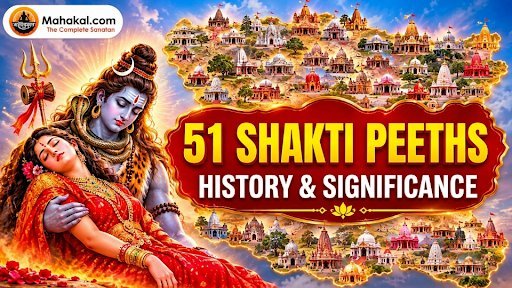
According to Hindu beliefs, these sacred places originated after Goddess Sati sacrificed her life following the humiliation of her husband, Lord Shiva, by her father, King Daksha. Overwhelmed by grief, Lord Shiva carried her body across the universe.
To restore cosmic balance, Lord Vishnu used his Sudarshan Chakra to divide Sati's body. It is believed that different parts of her body and ornaments fell at various locations, which later became sacred centres of Goddess worship known as Shakti Peethas.
These temples are considered powerful spiritual destinations and represent the divine presence of the Goddess in different forms.
1. Who Was Goddess Sati? The Story of Her Birth and Marriage to Lord Shiva
According to Hindu mythology, Goddess Sati was the daughter of Prajapati Daksha. She is considered an incarnation of Adi Shakti, the supreme feminine divine power.
From an early age, Sati developed deep devotion towards Lord Shiva. However, her father Daksha disapproved of Shiva because of his ascetic lifestyle and unconventional appearance.
Despite her father's opposition, Sati remained determined to marry Lord Shiva. Through intense devotion and spiritual dedication, she eventually won Shiva's acceptance.
Their marriage was an important divine union of consciousness and energy.
However, Daksha continued to hold resentment towards Lord Shiva. This disagreement eventually led to one of the most significant events in Hindu mythology: the story of Daksha's Yajna.
2. The Story of Daksha's Yajna: When a Father Insulted Lord Shiva
Prajapati Daksha once organised a grand yajna and invited several gods, sages and respected personalities.
However, he deliberately excluded his daughter Sati and her husband, Lord Shiva, from the ceremony.
When Sati learned about the yajna, she expressed her desire to attend it. Lord Shiva advised her against visiting a gathering where she and her husband had not been invited or respected.
Despite his concerns, Sati decided to visit her father's home.
Upon reaching the yajna, she realised that she was not welcomed with the respect she deserved. The situation became even more painful when she heard Daksha insulting Lord Shiva in front of the assembled guests.
Sati could not tolerate the humiliation of her husband and strongly opposed her father's behaviour.
3. Goddess Sati's Self-Sacrifice: The Beginning of the Shakti Peetha Tradition
According to the traditional account, Sati was deeply distressed by her father's disrespect towards Lord Shiva.
She declared that she no longer wished to continue living in a body connected to Daksha, who had insulted her husband.
She then gave up her physical body through yogic fire.
Different religious accounts describe the details of this event in different ways, but Sati's sacrifice remains central to the origin story of the Shakti Peethas.
When Lord Shiva learned about her death, he was overwhelmed with grief and anger.
According to the mythology, his anger gave rise to powerful manifestations such as Veerabhadra and Bhadrakali. Veerabhadra subsequently destroyed Daksha's yajna and punished him.
Later, Daksha was restored to life following divine intervention.
4. Lord Shiva's Cosmic Grief and the Mystery of the Sudarshan Chakra
After Sati's death, Lord Shiva carried her body and wandered across the universe in deep sorrow.
His grief was so immense that the balance of the universe was believed to be disturbed.
The gods became concerned about the consequences of Shiva's sorrow and the disruption of cosmic order.
At this point, Lord Vishnu intervened to restore balance. According to a widely followed tradition, he used his divine Sudarshan Chakra to divide Sati's body into different parts.
These parts, along with certain ornaments, fell at various locations across the Indian subcontinent.
The places where they fell became sacred centres known as Shakti Peethas.
At each Peetha, Goddess Shakti is worshipped under a particular name and form. Lord Shiva is also associated with each site in the form of a Bhairava, who is traditionally regarded as its guardian deity.
5. Why Are There 51 Shakti Peethas?
One common question among devotees is why the number of Shakti Peethas is traditionally given as 51.
This number is associated with Shakta and Tantric traditions. A widely recognised symbolic interpretation connects the 51 Peethas with the 51 letters of the Sanskrit alphabet and the divine Matrika energies.
According to this understanding, each letter represents a form of sacred sound and divine energy.
However, Hindu religious traditions do not provide only one universal count of Shakti Peethas. Different texts and traditions mention 18, 51, 52 and even 108 sacred seats of the Goddess.
Therefore, the number 51 should be understood as one of the most widely followed traditional enumerations rather than the only accepted count.
6. Names and Locations of the 51 Shakti Peethas
The following list follows one well-known tradition associated with the Pitha Nirnaya or Mahapithanirupana text. Some geographical identifications remain disputed.
| No. | Shakti Peetha | Traditional Location |
|---|---|---|
| 1 | Hingula | Hinglaj, Balochistan, Pakistan |
| 2 | Karavira | Kolhapur, Maharashtra |
| 3 | Sugandha | Shikarpur, Bangladesh |
| 4 | Kashmira | Kashmir region |
| 5 | Jwalamukhi | Kangra, Himachal Pradesh |
| 6 | Jalandhara | Jalandhar region, Punjab |
| 7 | Vaidyanatha | Deoghar, Jharkhand |
| 8 | Nepala | Nepal |
| 9 | Manasa | Lake Manasarovar region |
| 10 | Viraja | Jajpur, Odisha |
| 11 | Gandaki | Nepal |
| 12 | Bahula | Ketugram, West Bengal |
| 13 | Ujjayini | Ujjain or Ujani, according to different traditions |
| 14 | Chattala | Chandranath Hill, Bangladesh |
| 15 | Tripura Sundari | Udaipur, Tripura |
| 16 | Trisrota | Jalpaiguri, West Bengal |
| 17 | Kamakhya | Guwahati, Assam |
| 18 | Yugadya | Kshirgram, West Bengal |
| 19 | Kalipitha | Kalighat, Kolkata |
| 20 | Prayaga | Prayagraj, Uttar Pradesh |
| 21 | Jayanti | Sylhet region, Bangladesh |
| 22 | Kirita | Murshidabad, West Bengal |
| 23 | Varanasi | Manikarnika, Varanasi |
| 24 | Kanyashrama | Chittagong region, Bangladesh |
| 25 | Kurukshetra | Kurukshetra, Haryana |
| 26 | Manivedika | Exact location uncertain |
| 27 | Shrishaila | Shrishaila or Srihatta, according to different traditions |
| 28 | Kanchi | Kanchipuram or a location in West Bengal |
| 29 | Kalamadhava | Exact location uncertain |
| 30 | Shona | Son or Narmada River region |
| 31 | Ramagiri | Chitrakoot or Ramtek, according to different traditions |
| 32 | Vrindavana | Vrindavan, Uttar Pradesh |
| 33 | Shuchi | Exact location uncertain |
| 34 | Panchasagara | Exact location uncertain |
| 35 | Karatoya-tata | Bangladesh |
| 36 | Shriparvata | Traditionally associated with the Shrishaila region |
| 37 | Vibhasha | Tamluk, West Bengal |
| 38 | Prabhasa | Somnath, Gujarat |
| 39 | Bhairava Parvata | Ujjain region, Madhya Pradesh |
| 40 | Janasthana | Nashik, Maharashtra |
| 41 | Godavari-tira | Godavari River region |
| 42 | Ratnavali | Hooghly region, West Bengal |
| 43 | Mithila | Janakpur region, Nepal |
| 44 | Nalahati | Nalhati, West Bengal |
| 45 | Kalighata | Disputed identification in West Bengal |
| 46 | Vakreshvara | Bakreshwar, West Bengal |
| 47 | Yashora | Ishwaripur, Bangladesh |
| 48 | Attahasa | Labhpur region, West Bengal |
| 49 | Nandipura | Sainthia, West Bengal |
| 50 | Lanka | Traditionally associated with Sri Lanka |
| 51 | Virata | Rajasthan or West Bengal, according to different traditions |
Important Note: This list follows one textual tradition. The identification of certain places, their modern geographical locations and associated body parts varies across manuscripts, regional traditions and scholarly interpretations. Not every identification should be treated as an undisputed historical fact.
7. Shakti Peethas Beyond India's Borders
One fascinating aspect of the Shakti Peetha tradition is that it extends beyond the geographical boundaries of modern India.
Several sacred sites associated with Goddess Shakti are located in neighbouring countries.
Hinglaj Mata Temple, Pakistan
Located in the Hingol region of Balochistan, Hinglaj Mata Temple is one of the most important Hindu pilgrimage destinations outside India. It is traditionally identified with the Hingula Shakti Peetha.
Sugandha Shakti Peetha, Bangladesh
Located in the Shikarpur region, this sacred site is associated with Goddess Sugandha. It forms part of the traditional Shakti Peetha network.
Gandaki Shakti Peetha, Nepal
Nepal has a deep religious connection with the Gandaki River and the Shaligram tradition. The region also holds significance in Shakti Peetha traditions.
Lanka Shakti Peetha, Sri Lanka
Some traditional lists identify a Shakti Peetha in Sri Lanka and associate it with Goddess Indrakshi.
These sacred places reflect the widespread influence of Goddess worship throughout South Asia.
8. Religious Significance of the Major Shakti Peethas
Kamakhya Shakti Peetha, Assam
Located on Nilachal Hill in Guwahati, Kamakhya Temple is one of the most important centres of Shakti worship.
The Goddess is worshipped here as a symbol of creation and feminine energy. Unlike conventional temples, the main sacred object is a natural stone formation representing the Yoni, symbolising the creative power of the universe.
The annual Ambubachi Mela is one of the temple's most important religious celebrations.
Jwalamukhi Shakti Peetha, Himachal Pradesh
Jwalamukhi Temple is famous for its naturally occurring eternal flames. Devotees worship these flames as manifestations of the Goddess.
The temple represents divine energy through the symbolism of fire.
Kalighat Shakti Peetha, West Bengal
Located in Kolkata, Kalighat is one of the most prominent temples dedicated to Goddess Kali.
The temple is especially significant during Durga Puja and Kali Puja, when thousands of devotees visit to offer prayers.
Tripura Sundari Shakti Peetha, Tripura
Located in Udaipur, Tripura, this temple is dedicated to Goddess Tripura Sundari. She represents divine beauty, compassion and supreme feminine power.
Vishalakshi Shakti Peetha, Varanasi
Situated in the sacred city of Varanasi, the Vishalakshi Temple is an important centre of Goddess worship. Its spiritual importance is closely connected with the religious heritage of Kashi and Lord Shiva.
9. Shakti Peethas in Ujjain: The Divine Connection Between Lord Shiva and Goddess Shakti
Ujjain, located in Madhya Pradesh, is one of India's most important spiritual destinations. It is internationally known for the Mahakaleshwar Jyotirlinga, but the city also has a remarkable tradition of Goddess worship.
The Harsiddhi Mata Temple is among the most famous temples of Ujjain and is associated with the Ujjayini Shakti Peetha tradition.
According to certain beliefs, the elbow of Goddess Sati fell at this sacred location.
The temple is particularly famous for its two magnificent Deep Stambhas, which are illuminated with numerous lamps during Navratri.
Another important temple is the Garh Kalika Mata Temple, which is also associated with the ancient religious heritage of Ujjain.
However, different local and religious traditions identify the Ujjayini Shakti Peetha with different locations, including Harsiddhi and Garh Kalika.
The presence of both Lord Mahakaleshwar and important Goddess temples makes Ujjain a significant destination for devotees of Shiva and Shakti.
10. Why Is Bhairava Worship Important at Every Shakti Peetha?
One distinctive feature of Shakti Peethas is the association of each Goddess shrine with a corresponding form of Bhairava.
In Shakta traditions, Bhairava is regarded as the guardian of the sacred Peetha.
Each location has a particular name for the Goddess and an associated form of Lord Shiva.
This relationship carries deep spiritual symbolism. Goddess Shakti represents divine energy, while Lord Shiva represents consciousness.
Together, they symbolise the inseparable relationship between energy and consciousness in the universe.
For this reason, worshipping the Goddess and offering prayers to Bhairava are both considered important parts of the traditional pilgrimage.
11. What Is the Spiritual Significance of Visiting Shakti Peethas?
Devotees believe that visiting Shakti Peethas brings spiritual peace, positivity and inner strength.
People visit these sacred places to seek the blessings of the Goddess for family happiness, prosperity, protection and strength during difficult times.
During Navratri, many Shakti Peethas organise special religious ceremonies, Durga Saptashati recitations, havans, devotional singing and Kanya Pujan.
For devotees, these temples are not merely places of worship but also centres of faith, spiritual discipline and cultural heritage.
Religious blessings and the fulfilment of wishes are matters of personal faith and should not be understood as guaranteed outcomes.
12. Life Lessons from the Story of the 51 Shakti Peethas
The story of Goddess Sati and Lord Shiva carries several important spiritual and moral lessons.
-
Importance of Respect: Every relationship requires mutual respect, understanding and dignity.
-
Consequences of Ego: Daksha's arrogance became the cause of his downfall. The story reminds us that humility is greater than power or status.
-
Unity of Energy and Consciousness: The relationship between Shiva and Shakti symbolises the importance of energy and consciousness in creation.
-
Power of Devotion: Goddess Sati's devotion and dedication remain important ideals in Hindu spiritual traditions.
-
Importance of Balance: Lord Vishnu's intervention represents the need to restore harmony and balance during difficult situations.
Conclusion: The 51 Shakti Peethas Represent the Eternal Power of Goddess Sati
The tradition of the 51 Shakti Peethas represents the widespread worship of Goddess Shakti and the spiritual unity of Hindu traditions.
The story of Goddess Sati, Lord Shiva's grief and Lord Vishnu's role in restoring cosmic balance gives these sacred places their unique religious significance.
From India to Nepal, Bangladesh, Pakistan and Sri Lanka, the Shakti Peetha tradition reflects the deep cultural and spiritual influence of Goddess worship across South Asia.
Visiting these sacred places is not only a religious experience but also an opportunity to understand India's ancient mythology, spiritual heritage and devotion to the Divine Mother.
Jai Mata Di!
What's Your Reaction?