The Story of King Bali and Vamana Avatar: How Did Lord Vishnu Measure the Entire Universe in Just Three Steps?
Discover the fascinating story of King Bali and Lord Vishnu's Vamana Avatar. Learn the mystery of the three steps of land, the cosmic form of Lord Vishnu, King Bali's sacrifice and his connection with Sutala Loka.
The Story of King Bali and Vamana Avatar: How Did Lord Vishnu Measure the Entire Universe in Just Three Steps?
Among the most fascinating stories in Hindu mythology is the divine tale of King Mahabali and Lord Vishnu's Vamana Avatar. This story is not only about the restoration of cosmic balance but also teaches important lessons about charity, devotion, truthfulness, sacrifice and surrender to God.
King Mahabali, also known as Bali Maharaj, was a powerful ruler born into the Asura dynasty. Despite his background, he was known for his generosity, courage and commitment to his people. Through his strength and determination, he conquered the three worlds and established his influence over the universe.
As his power increased, the gods became concerned about losing their authority. To restore the balance, Lord Vishnu decided to take the form of a small Brahmin boy known as Vamana.
When Vamana arrived at King Bali's grand sacrificial ceremony, he asked for only three steps of land. The king considered this a very small request and immediately agreed to fulfil it.
However, he did not know that the seemingly ordinary Brahmin boy was Lord Vishnu himself. As soon as the promise was made, Vamana transformed into a gigantic cosmic form and measured the entire universe in just two steps.
But what happened to the third step? Why did King Bali offer his own head? And why did Lord Vishnu grant him the kingdom of Sutala?
Let us explore the complete mythological story of King Bali and Lord Vishnu's Vamana Avatar.
1. Who Was King Mahabali? Know His Birth and Family Background
King Mahabali was one of the most powerful and respected Asura kings described in Hindu scriptures. He was the grandson of Prahlada and the son of Virochana.
Prahlada was a great devotee of Lord Vishnu, whose devotion is closely associated with the Narasimha Avatar of Lord Vishnu.
Virochana continued the lineage, and his son Mahabali eventually became a powerful ruler.
King Bali inherited several qualities associated with his grandfather Prahlada, including devotion, generosity and respect for religious traditions.
He was known for his charitable nature and commitment to his subjects. People who approached his kingdom seeking help were traditionally believed to receive generous support.
His courage, leadership and generosity made him famous across the three worlds.
However, as his kingdom expanded, he eventually gained control over Swarga Loka, the celestial realm of the gods. This development created a conflict between King Bali and the Devas.
2. How Did King Bali Conquer the Three Worlds?
According to Hindu mythology, King Bali expanded his kingdom through his extraordinary strength, determination and military power.
He defeated Indra, the king of the Devas, and gained control over Swarga Loka.
As a result, the gods lost their authority over their celestial kingdom and became deeply concerned about the growing influence of King Bali.
Indra and the other gods approached Lord Vishnu and requested his help in restoring their position.
However, an important aspect of this story is that King Bali is not simply portrayed as an ordinary evil ruler. He was also a generous and capable king whose growing ambition created a conflict over the control of the three worlds.
Instead of choosing a conventional battle, Lord Vishnu decided to resolve the situation through a divine plan.
3. Why Did Lord Vishnu Take the Vamana Avatar?
When the gods approached Lord Vishnu for help, he assured them that he would restore cosmic balance.
This part of the story is closely connected with Goddess Aditi and Sage Kashyapa.
Aditi was the mother of the Devas. Seeing her sons deprived of their celestial kingdom, she became deeply worried and prayed to Lord Vishnu for their protection.
Pleased with her devotion and prayers, Lord Vishnu decided to take birth as her son.
In due course, Lord Vishnu appeared as Vamana, his fifth incarnation among the traditional ten principal avatars.
The word Vamana means dwarf or a person of small stature.
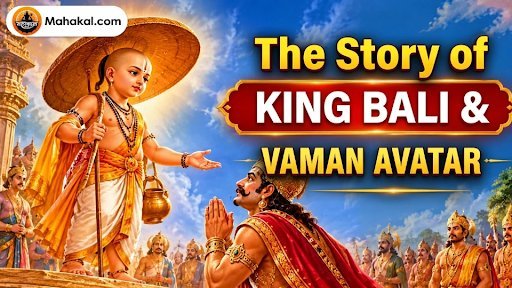
In this incarnation, Lord Vishnu appeared as a young Brahmin boy carrying a small umbrella, a water pot and a staff.
Although his physical appearance was small, his divine radiance and spiritual power were extraordinary.
This form carries an important message: the greatness of divine power cannot be judged by physical appearance.
4. Why Did Lord Vamana Visit King Bali's Yajna?
King Bali was performing a grand sacrificial ceremony to celebrate his power and establish his religious prestige.
The ceremony was being conducted under the guidance of Brahmin priests associated with the Bhrigu lineage.
During the yajna, King Bali was generously distributing gifts and donations to Brahmins and visitors.
At this moment, Lord Vishnu arrived at the sacrificial ground in the form of Vamana.
His divine appearance attracted everyone's attention. King Bali respectfully welcomed him, offered him a seat and performed traditional worship.
The king then invited Vamana to ask for anything he desired.
He was ready to offer gold, wealth, land, cattle or any other valuable possession.
However, Lord Vamana made an unexpected request that would change the course of the entire story.
5. The Mystery of Three Steps of Land: What Did Lord Vamana Ask For?
Lord Vamana asked King Bali for only three steps of land.
The request surprised the king because he had expected the young Brahmin to ask for something much greater.
King Bali told him that he could ask for more land, wealth or valuable possessions instead of such a small gift.
However, Lord Vamana remained firm in his request.
He explained that a person who constantly desires more than necessary can never achieve true satisfaction. Therefore, he only wanted as much land as he could measure in three steps.
The request appeared simple, but it was part of a divine plan through which Lord Vishnu was about to reveal his supreme cosmic form.
King Bali accepted the request and prepared to fulfil his promise.
However, his spiritual teacher, Shukracharya, soon realized the true identity of the young Brahmin.
6. Why Did Shukracharya Stop King Bali From Giving the Land?
When King Bali agreed to donate three steps of land, his guru Shukracharya tried to stop him.
Shukracharya understood that the young Brahmin was none other than Lord Vishnu, who had appeared to help the Devas regain their lost kingdom.
He warned King Bali that this was not an ordinary request.
If Bali fulfilled the promise, he could lose his entire kingdom because Lord Vishnu possessed unlimited divine power.
Shukracharya advised the king to reconsider his decision and avoid making the donation.
However, King Bali was famous for keeping his promises.
He believed that once a person had promised something to a deserving visitor, withdrawing that promise would be against the principles of truthfulness and generosity.
Despite his guru's warning, King Bali decided to honour his commitment.
This moment reveals one of the most important qualities of King Bali: he was willing to sacrifice his possessions rather than break his word.
7. The Cosmic Form of Lord Vamana: How Did He Measure the Universe in Two Steps?
After King Bali confirmed his promise, Lord Vamana began expanding into an extraordinary cosmic form.
His body grew so enormous that it appeared to encompass the entire universe.
His first step covered the earthly realm, while his second step extended across the heavenly regions and higher worlds.
All the gods, sages and people present at the sacrificial ceremony were astonished by this magnificent divine manifestation.
King Bali finally understood that the young Brahmin was not an ordinary visitor but Lord Vishnu himself.
The First Step: Lord Vishnu measured the earthly realm and its associated regions with his first step.
The Second Step: With his second step, he covered the heavenly and higher worlds.
After these two steps, no space remained for the third step that King Bali had promised.
Lord Vamana then asked the king where he should place his third step.
This became the most important moment in the entire story.
8. Why Did King Bali Offer His Head for the Third Step?
When Lord Vamana asked for the place to complete his third step, King Bali found himself in a difficult situation.
His kingdom had already been measured by the divine form of Lord Vishnu. There was no remaining land that he could offer.
However, King Bali did not withdraw his promise.
He told Lord Vishnu that he could place the third step on his head.
Since he had promised three steps of land, he believed that fulfilling his word was his responsibility.
If the entire universe had already been covered by the Lord's first two steps, then his own head was the only remaining offering he could make.
King Bali bowed before Lord Vishnu and offered himself completely.
This moment represents one of the deepest spiritual teachings of the story.
The first two steps represent the surrender of the external world, while the third step represents the surrender of the individual self.
The message is that true devotion is not limited to donating wealth or possessions. It also requires humility and the willingness to surrender one's ego before God.
9. What Boon Did Lord Vishnu Give to King Bali?
Lord Vishnu was pleased with King Bali's honesty, generosity and complete surrender.
Instead of simply punishing him, the Lord granted him a special blessing.
King Bali was made the ruler of Sutala Loka, a magnificent realm described in Hindu scriptures as a prosperous and beautiful world.
Lord Vishnu also promised to remain personally present as his protector and guardian.
This blessing is particularly significant because it demonstrates that the story was not merely about the defeat of a powerful king.
It was also about the relationship between God and a devotee who remained truthful even when faced with the loss of everything he possessed.
King Bali received authority over Sutala and the divine presence of Lord Vishnu.
Thus, the Vamana Avatar story became an example of devotion, faith, sacrifice and divine grace.
10. Does Lord Vishnu Still Stay With King Bali?
According to the Shrimad Bhagavata Mahapurana, Lord Vishnu granted King Bali a special position in Sutala Loka and assured him of divine protection.
The Lord's presence in Sutala is regarded as one of the greatest blessings received by King Bali.
Some Hindu religious traditions also describe Lord Vishnu as residing at King Bali's entrance and protecting him.
This belief highlights the importance of devotion and surrender in Hindu spirituality.
King Bali was born into the Asura dynasty, yet his devotion, truthfulness and generosity earned him a special place among the devotees of Lord Vishnu.
The story teaches that divine grace is not determined merely by one's birth or family background.
11. What Is the Connection Between King Bali, Onam and Bali Pratipada?
The story of King Mahabali is closely connected with several Indian festivals and regional traditions.
In Kerala, the festival of Onam is celebrated in memory of King Mahabali.
According to Kerala's popular traditional folklore, Mahabali was a generous and beloved ruler whose kingdom was marked by happiness, prosperity and equality.
It is believed that King Mahabali visits his people during the Onam festival.
For this reason, Onam is celebrated with great enthusiasm through traditional feasts, floral decorations, cultural performances and family gatherings.
Another festival associated with King Bali is Bali Pratipada, which is observed in several regions during the period following Diwali.
Some regional traditions connect this occasion with the memory of King Mahabali and his generosity.
It is important to understand that the popular Onam folklore and the Vamana Avatar narrative in the Shrimad Bhagavata Purana contain different cultural details. However, both traditions preserve deep respect for King Mahabali.
12. Five Important Life Lessons From the Vamana Avatar Story
The story of King Bali and Lord Vamana is more than an ancient mythological narrative. It offers several valuable lessons for everyday life.
1. The Importance of Keeping Promises
King Bali understood that fulfilling his promise could cost him his kingdom, yet he chose to honour his word.
2. The Need to Overcome Ego
The story reminds us that no matter how powerful a person becomes, arrogance should never control their decisions.
3. The True Meaning of Charity
Charity is not limited to giving money or material possessions. It also involves generosity, sacrifice and selflessness.
4. The Unlimited Power of God
The cosmic form of Lord Vamana demonstrates that divine power cannot be restricted by physical size or appearance.
5. Complete Surrender Is an Important Part of Devotion
By offering his head at the feet of Lord Vishnu, King Bali demonstrated complete surrender and faith.
13. Religious and Spiritual Significance of the Vamana Avatar
The Vamana Avatar is traditionally considered the fifth incarnation of Lord Vishnu among the ten principal avatars.
This incarnation is associated with restoring cosmic balance, protecting the Devas and testing the devotion and commitment of King Bali.
The contrast between Vamana's small physical appearance and his enormous cosmic form carries a deep spiritual meaning.
The small form teaches that divine power may appear in the simplest of forms. Therefore, appearances should never be used to judge someone's true worth.
The cosmic form demonstrates that the entire universe exists within the supreme divine power.
King Bali's surrender represents the depth of the relationship between a devotee and God.
Together, these teachings make the Vamana Avatar one of the most meaningful stories of Hindu mythology.
Conclusion
The story of King Bali and Lord Vishnu's Vamana Avatar is one of the most inspiring narratives in Hindu mythology.
It reveals the divine power of Lord Vishnu and introduces us to a king who refused to abandon his promise even when he knew that he might lose his entire kingdom.
Lord Vamana asked for only three steps of land but revealed his cosmic form and covered the universe in two steps.
When no space remained for the third step, King Bali offered his own head.
Impressed by his honesty, generosity and complete surrender, Lord Vishnu granted him the kingdom of Sutala and promised his divine protection.
The greatest lesson of this story is that true charity is not merely about giving away wealth. It is also about surrendering ego, respecting one's promises and remaining committed to truth.
Jai Shri Hari Vishnu!
What's Your Reaction?