History of Jagannath Puri Temple: How Did Lord Jagannath, Balabhadra and Subhadra Appear? Discover Their Divine Story
Discover the history of Jagannath Puri Temple in Odisha, the legend of King Indradyumna, the divine appearance of Lord Jagannath, Balabhadra and Subhadra, the famous Rath Yatra and the temple's spiritual significance.
The Sacred Abode of Lord Jagannath
India is home to countless ancient temples known for their spiritual traditions, fascinating histories and religious significance. Among them, the Jagannath Puri Temple, located on the coast of Odisha, holds a special place in Hinduism.
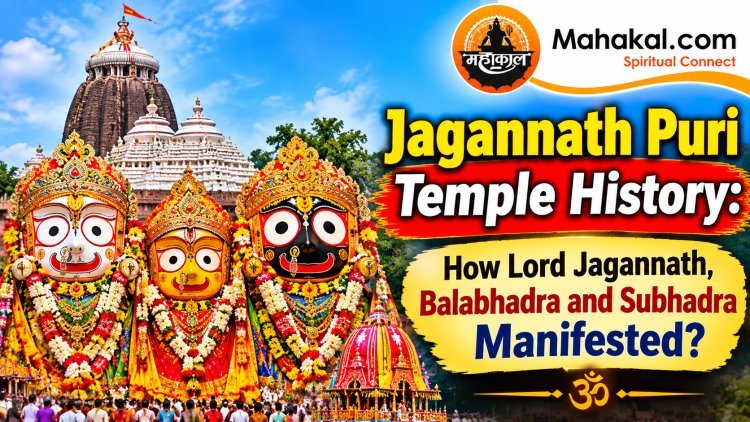
Dedicated to Lord Jagannath, a revered form of Lord Vishnu, the temple is famous for worshipping three divine figures together: Lord Jagannath, His elder brother Lord Balabhadra and their younger sister Goddess Subhadra.
Jagannath Puri is considered one of the four sacred Char Dham pilgrimage sites of Hinduism. One of the most distinctive features of this temple is that its principal deities are made of sacred wood rather than stone or metal. Their wooden forms are renewed through a special religious tradition known as Nabakalebara.
But how did these unique idols come into existence? Why do the deities have distinctive forms with unfinished-looking arms and legs? Let us explore the history of Jagannath Puri Temple and the fascinating legend behind the appearance of Lord Jagannath, Balabhadra and Subhadra.
1. Where Is Jagannath Puri Temple Located?
The Jagannath Temple is situated in the holy city of Puri, in the Indian state of Odisha, along the coast of the Bay of Bengal.
Puri is also known by sacred names such as Purushottama Kshetra, Srikshetra and Nilachala in religious traditions. The city is an important centre of Hindu pilgrimage and Odisha's cultural heritage.
Every year, devotees from different parts of India and abroad visit Puri to seek the blessings of Lord Jagannath.
2. Historical Background of Jagannath Puri Temple
The present grand structure of Jagannath Temple is primarily associated with the 12th century. Historical records and temple accounts connect its construction with King Anantavarman Chodaganga Deva of the Eastern Ganga dynasty.
The temple was developed further under later rulers, who contributed to its expansion and architectural features.
Built in the traditional Kalinga style of architecture, the temple is known for its towering structure and magnificent complex. Its important architectural sections include:
-
Vimana: The main sanctum where the deities reside.
-
Jagamohan: The assembly hall in front of the sanctum.
-
Natamandira: The dance and ceremonial hall.
-
Bhogamandapa: The hall associated with offerings to the deities.
The temple complex is enclosed by massive walls and has four main gateways. The eastern entrance is known as Singhadwara, or the Lion Gate. The sacred Nilachakra, associated with Lord Vishnu's Sudarshana Chakra, is installed on the temple's main tower.
The history of the present temple should be distinguished from the ancient legends associated with King Indradyumna, who is traditionally credited with establishing an earlier shrine to Lord Jagannath.
3. The Divine Appearance of Lord Jagannath: The Legend of King Indradyumna
One of the most popular legends associated with Lord Jagannath tells the story of King Indradyumna.
According to religious tradition, King Indradyumna was a devoted follower of Lord Vishnu. He wished to see the Lord's divine form and establish a magnificent temple in His honour.
One day, the king learned about a mysterious form of Lord Vishnu known as Nilamadhava. It was believed that a forest-dwelling devotee named Vishvavasu secretly worshipped this divine form.
The king sent his messenger, Vidyapati, to discover the location of Nilamadhava.
After several efforts, Vidyapati became closely associated with Vishvavasu's family and married his daughter. According to the traditional story, Vishvavasu eventually agreed to take Vidyapati to the place where Nilamadhava was worshipped. He covered Vidyapati's eyes during the journey, but Vidyapati secretly left signs along the path so that he could identify the route later.
When King Indradyumna finally reached the location, Nilamadhava had disappeared. The king was deeply saddened and prayed sincerely to the Lord.
According to the legend, Lord Vishnu appeared to him in a dream and instructed him to look for a divine wooden log that would arrive on the seashore. The king was told that the sacred wood would be used to create the new divine images.
4. How Were the Idols of Jagannath, Balabhadra and Subhadra Created?
According to the traditional legend, a special wooden log appeared on the seashore. It was believed to be no ordinary piece of wood but a divine manifestation.
King Indradyumna arranged for the sacred wood to be brought with great respect and searched for a skilled craftsman who could create the deities.
At this moment, an elderly craftsman appeared before the king. In the religious story, he is regarded as Lord Vishwakarma, the divine architect.
The craftsman agreed to create the idols but placed one condition: nobody should open the workshop door until his work was completed.
The king accepted the condition. The craftsman began working inside the closed room.
Several days passed, and eventually the sounds of carving stopped. Queen Gundicha became worried that something might have happened to the craftsman. Concerned about his well-being, the king finally ordered the door to be opened.
According to the legend, the craftsman had disappeared. Inside the room were the images of Lord Jagannath, Lord Balabhadra and Goddess Subhadra. However, their arms and legs appeared unfinished.
The king regretted breaking the condition. But he received a divine message that the deities wished to remain in those very forms. The three sacred images were then ceremonially installed and worshipped.
Spiritual significance: The distinctive forms of the deities remind devotees that the divine cannot be judged by ordinary standards of physical appearance. True devotion lies in faith, love and surrender to God.
5. Religious Significance of Lord Jagannath, Balabhadra and Subhadra
The three deities are worshipped together in the main sanctum of Jagannath Temple. Each represents a distinct spiritual quality.
Lord Jagannath
Lord Jagannath is worshipped as a form of Lord Vishnu and Lord Krishna. The word Jagannath means "Lord of the Universe."
His large circular eyes and distinctive smile make His appearance unique. Devotees associate Him with compassion, universal love and divine grace.
Lord Balabhadra
Lord Balabhadra, also known as Balarama, is the elder brother of Lord Krishna. He represents strength, courage, patience and the protection of righteousness.
His idol is traditionally white in colour, and He occupies a place beside Lord Jagannath.
Goddess Subhadra
Goddess Subhadra is the sister of Lord Krishna and Lord Balabhadra. Her idol is traditionally yellow in colour.
She is associated with auspiciousness, compassion, affection and divine feminine energy.
The presence of all three deities together conveys the values of family, unity, love and divine connection.
6. The World-Famous Rath Yatra of Jagannath Puri
The annual Rath Yatra is one of the most important religious festivals associated with Jagannath Temple.
It takes place on the second day of the bright fortnight of the Hindu month of Ashadha.
During this grand celebration, Lord Jagannath, Lord Balabhadra and Goddess Subhadra are placed on beautifully decorated chariots and taken out of the temple in a ceremonial procession.
Each deity has a separate chariot:
-
Nandighosha: The chariot of Lord Jagannath.
-
Taladhwaja: The chariot of Lord Balabhadra.
-
Darpadalana (Devadalana): The chariot of Goddess Subhadra.
Thousands of devotees gather to pull the chariots with sacred ropes. The procession travels towards the Gundicha Temple, and after a few days, the deities return to their original temple in a journey known as Bahuda Yatra.
The festival carries a special spiritual message: the Lord comes out of the temple to give darshan to devotees. It is one of the most widely recognised religious celebrations associated with Odisha.
7. Why Is Mahaprasad Special at Jagannath Temple?
Mahaprasad is one of the most cherished traditions of Jagannath Puri Temple.
A variety of traditional food preparations are offered to the deities as bhog. After the offering, the food is regarded as Mahaprasad and received by devotees as the Lord's blessing.
The temple kitchen is famous for preparing food using traditional methods and earthen pots. Devotees can also experience the tradition of Mahaprasad at Anand Bazaar, located within the temple complex.
The tradition represents devotion, sharing and equality. It reminds devotees that food offered to the Lord is received with reverence and shared as a blessing.
8. Nabakalebara: The Sacred Renewal of the Wooden Deities
One of the most distinctive traditions of Jagannath Temple is Nabakalebara.
The word Nabakalebara means "taking on a new body."
During this special ritual, the wooden idols of Lord Jagannath, Lord Balabhadra, Goddess Subhadra and Sudarshana are replaced with newly prepared sacred images according to prescribed religious procedures.
This ritual does not take place every year. It is performed according to specific calendar conditions and generally occurs at intervals of around 12 to 19 years.
The process involves identifying sacred neem trees, performing traditional rituals and preparing the new wooden images.
Nabakalebara also carries a deeper spiritual message about transformation, renewal and the temporary nature of the physical body.
9. Interesting Facts About Jagannath Puri Temple
-
Jagannath Puri is one of the four sacred Char Dham pilgrimage sites of Hinduism.
-
Lord Jagannath is worshipped along with Lord Balabhadra and Goddess Subhadra.
-
The three principal idols are made of sacred wood.
-
The present historical temple structure is associated with the 12th century.
-
The temple follows the traditional Kalinga style of architecture.
-
The sacred Nilachakra is installed on the main temple tower.
-
The annual Rath Yatra is famous across the world.
-
The temple's Mahaprasad and Anand Bazaar are important parts of its traditions.
-
The Nabakalebara ceremony renews the wooden deities according to special religious rules.
10. The Spiritual Message of Jagannath Puri Temple
Jagannath Puri Temple is more than an architectural monument or a place of worship. It represents devotion, compassion, service and unity.
The form of Lord Jagannath reminds devotees that divine grace is not limited by language, region or social background.
The three deities together represent the importance of family and togetherness. The Rath Yatra expresses the belief that the Lord comes among His devotees, while the Mahaprasad tradition teaches the values of sharing and community.
Conclusion
The history of Jagannath Puri Temple is a remarkable blend of faith, mythology and Indian cultural heritage.
From the legend of King Indradyumna and Nilamadhava to the unique wooden forms of Lord Jagannath, Balabhadra and Subhadra, every tradition of this sacred temple carries a deep spiritual meaning.
The present temple, associated with the 12th century, continues to be a major centre of devotion. Its Rath Yatra, Mahaprasad and Nabakalebara traditions give Jagannath culture a unique identity.
Jai Jagannath! ????
What's Your Reaction?