The Complete Story of Lord Shiva and Goddess Parvati's Marriage: From Sati's Sacrifice to the Divine Union of Shiva and Shakti
Discover the complete mythological story of Lord Shiva and Goddess Parvati's marriage, including Goddess Sati's sacrifice, Parvati's birth, her intense penance, Kamadeva's destruction, Shiva's divine test and their celestial wedding.
The Complete Story of Lord Shiva and Goddess Parvati's Marriage: From Sati's Sacrifice to the Divine Union of Shiva and Shakti
The marriage of Lord Shiva and Goddess Parvati is one of the most sacred and fascinating stories in Hindu mythology. It is not merely the story of a divine wedding but a beautiful representation of love, devotion, sacrifice, patience and the eternal union of Shiva and Shakti.
Lord Shiva is worshipped as Mahadev, the supreme deity, while Goddess Parvati is regarded as the embodiment of Adi Shakti, the primordial divine energy.
But did you know that before marrying Goddess Parvati, Lord Shiva was married to Goddess Sati? Why did Sati sacrifice her life during the grand yajna organised by her father, Daksha? Why did Parvati perform such severe penance to marry Lord Shiva? And why did Kamadeva attempt to interrupt Shiva's meditation?
The answers to these questions are found in the fascinating mythological story of Shiva and Parvati's marriage.
Let us explore the complete story, beginning with Goddess Sati's sacrifice, Parvati's divine birth, her intense penance and the grand celestial wedding of Lord Shiva and Goddess Parvati.
1. The Marriage of Goddess Sati and Lord Shiva
According to Hindu mythology, Goddess Sati was the daughter of Prajapati Daksha, one of the prominent sons of Lord Brahma.
From childhood, Sati was deeply devoted to Lord Shiva. She considered Mahadev her ideal divine companion and wished to marry him.
However, Prajapati Daksha strongly disapproved of Lord Shiva. He disliked Shiva's ascetic lifestyle, matted hair, ash-covered body and association with unusual beings and spirits.
Despite her father's opposition, Goddess Sati remained determined to marry Lord Shiva.
Eventually, Lord Shiva and Goddess Sati were married, and Sati went to live with him at Mount Kailash.
However, Daksha continued to harbour resentment towards Lord Shiva. This hostility eventually led to one of the most significant events in Hindu mythology.
2. Daksha Yajna and Goddess Sati's Sacrifice
Once, Prajapati Daksha organised a grand yajna and invited numerous gods, sages and celestial beings.
However, he deliberately excluded Lord Shiva and Goddess Sati from the invitation.
When Sati learned about the yajna, she expressed her desire to attend the ceremony at her father's home.
Lord Shiva advised her that attending an event without an invitation could lead to disrespect and emotional pain. He explained that one should avoid visiting a place where there is no respect or affection.
Nevertheless, Sati wished to meet her family and decided to attend the ceremony alone.
Upon reaching the yajna, she discovered that arrangements had been made for all the invited deities, but there was no place or honour reserved for Lord Shiva.
When Sati questioned her father, Daksha began insulting Mahadev in front of everyone.
Unable to tolerate the humiliation of her beloved husband, Goddess Sati became deeply distressed.
She felt that she could no longer continue living in a body associated with a father who had insulted her divine husband.
According to the legend, she used her yogic powers to sacrifice her body in the sacred fire of the yajna.
The entire gathering was filled with grief and shock.
3. Lord Shiva's Anger and the Appearance of Veerabhadra
When Lord Shiva learned about Goddess Sati's sacrifice, he was overcome with immense sorrow and anger.
According to the mythological account, Mahadev pulled a strand of hair from his matted locks and struck it upon the ground.
From it emerged the mighty warrior Veerabhadra. Goddess Bhadrakali and a powerful army of Shiva's attendants also appeared.
Lord Shiva commanded Veerabhadra to destroy Daksha's yajna.
Veerabhadra arrived at the ceremony and brought destruction upon the gathering. During the incident, Daksha was beheaded, and several participants were punished.
Later, following the prayers of the gods and sages, Lord Shiva's anger subsided.
He restored Daksha's life by giving him the head of a goat.
However, Lord Shiva remained deeply affected by the loss of Goddess Sati. He withdrew from worldly activities and immersed himself in intense meditation.
4. The Rebirth of Goddess Sati: The Birth of Goddess Parvati
After Sati's departure, the gods became concerned about the cosmic balance.
According to Hindu beliefs, the reunion of Shiva and Shakti was necessary for maintaining the balance of creation.
Goddess Adi Shakti was therefore reborn as the daughter of King Himavan, the ruler of the Himalayas, and his wife Queen Menavati.
The divine child was named Parvati. She is also known by names such as Girija and Shailaputri.
From childhood, Parvati was beautiful, intelligent, spiritual and deeply devoted to Lord Shiva.
According to traditional stories, Sage Narada once visited the royal family and revealed that Parvati was destined to marry Lord Shiva.
This prediction strengthened Parvati's determination to accept Mahadev as her husband.
5. Goddess Parvati's Intense Penance to Win Lord Shiva
Goddess Parvati knew that Lord Shiva had withdrawn from worldly life and was deeply immersed in meditation.
Winning his acceptance would not be easy, but she remained determined.
She decided to abandon the comforts of royal life and began performing severe penance in the forest to please Mahadev.
Initially, she survived on fruits and roots. Later, she reduced her food intake and began surviving only on leaves.
According to popular mythology, she eventually gave up even dry leaves.
Because of this extraordinary sacrifice, she became known as Aparna, meaning the goddess who did not consume leaves.
For years, Parvati continued her difficult penance without being disturbed by heat, cold or rain.
Her devotion and determination amazed the sages and celestial beings.
Her tapasya was not simply an expression of her desire for marriage; it represented the divine effort to reunite Shiva and Shakti.
6. The Terror of Tarakasura and the Concern of the Gods
During this period, a powerful demon named Tarakasura began creating destruction throughout the three worlds.
According to mythology, Tarakasura had received a boon that he could only be defeated by a son of Lord Shiva.
However, after the loss of Goddess Sati, Shiva had withdrawn from worldly life and remained absorbed in meditation.
The gods realised that the marriage of Shiva and Parvati was essential for the birth of a divine son who could defeat Tarakasura.
They therefore decided to find a way to awaken Lord Shiva from his deep meditation and bring his attention towards Goddess Parvati.
7. Why Did Kamadeva Attempt to Disturb Lord Shiva's Meditation?
The gods approached Kamadeva, the deity of love and desire, and requested his help in awakening Lord Shiva.
Kamadeva arrived at the place where Mahadev was meditating, accompanied by his wife Rati.
At that time, Goddess Parvati was also present, serving and worshipping Lord Shiva.
Taking advantage of the moment, Kamadeva released one of his flower-tipped arrows towards Shiva.
The arrow disturbed Mahadev's meditation.
When Lord Shiva opened his eyes, he immediately realised what Kamadeva had done.
Filled with anger, he opened his third eye.
A powerful flame emerged from his third eye and reduced Kamadeva's physical body to ashes.
Kamadeva's wife, Rati, was devastated by the incident and began mourning.
Lord Shiva later consoled her, and Kamadeva came to be associated with the invisible or bodiless form known as Ananga.
This famous episode is remembered as Kamadeva Dahan.
8. Lord Shiva Tests Goddess Parvati by Disguising Himself as a Sage
Although Lord Shiva was pleased with Parvati's devotion, he wished to test the strength of her determination.
According to the traditional story, Mahadev disguised himself as a sage or Brahmin and approached Goddess Parvati.
He asked her why she was performing such difficult penance.
When Parvati explained that she wished to marry Lord Shiva, the disguised sage began criticising Mahadev.
He questioned why a beautiful princess would wish to marry someone who lived in cremation grounds, covered himself in ashes, wore snakes and possessed no royal wealth or worldly comforts.
He suggested that Parvati should choose a more suitable husband.
Hearing these words, Goddess Parvati became upset.
She firmly defended Lord Shiva, explaining that his divine greatness could never be measured by his physical appearance or material possessions.
She declared that Mahadev was the supreme and most benevolent deity.
Impressed by her unwavering devotion, Lord Shiva revealed his true divine form.
He accepted her love and agreed to marry her.
9. Preparations for the Divine Wedding of Shiva and Parvati
After accepting Goddess Parvati as his future wife, Lord Shiva's decision brought immense happiness to the celestial world.
King Himavan and Queen Menavati were also delighted to hear the news.
Preparations for the divine wedding began.
Gods, sages, celestial musicians, yakshas, kinnaras and other divine beings were invited to attend the ceremony.
Lord Shiva's wedding procession included his unusual attendants, known as Shiva Ganas, along with various supernatural beings.
Mahadev began his journey towards the Himalayas in his distinctive ascetic appearance.
10. Why Was Queen Menavati Frightened by Lord Shiva's Wedding Procession?
When Lord Shiva's wedding procession reached the Himalayas, everyone witnessed an extraordinary sight.
The gods appeared in beautiful celestial forms, but the Shiva Ganas looked quite unusual.
Some appeared as spirits, others as ghosts, while many were covered in ash and carried tridents or played damru drums.
Seeing the unusual procession, Queen Menavati became frightened.
She wondered how her beautiful royal daughter could marry a groom who appeared so strange and unconventional.
Lord Vishnu and the other gods reassured her that Lord Shiva's appearance was unlike that of ordinary beings, but his divine nature was supreme and benevolent.
According to popular traditions, Lord Shiva then revealed his magnificent and beautiful divine form.
Everyone was delighted by his radiant appearance, and the wedding celebrations continued.
11. The Divine Marriage of Lord Shiva and Goddess Parvati
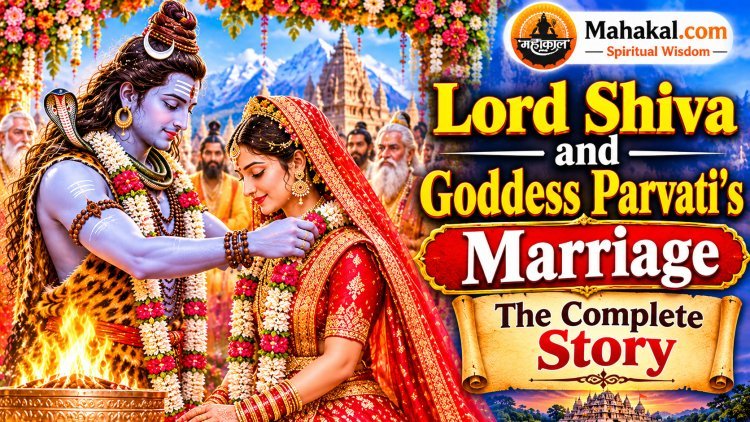
Finally, the auspicious moment arrived for the marriage of Lord Shiva and Goddess Parvati.
According to Hindu traditions, the divine wedding took place in the sacred Himalayan region and was attended by numerous gods, sages and celestial beings.
Lord Brahma performed the sacred wedding rituals, while Lord Vishnu and other deities witnessed the divine occasion.
King Himavan performed the Kanyadaan ceremony, offering his beloved daughter Parvati's hand in marriage to Lord Shiva.
With sacred Vedic mantras and the holy fire as witnesses, the marriage rituals were completed.
Thus, the divine union of Lord Shiva and Goddess Parvati took place.
This marriage represents the eternal union of Shiva and Shakti.
Shiva symbolises pure consciousness, while Shakti represents divine energy and creation. Their union is regarded as essential for maintaining the balance of the universe.
12. The Birth of Lord Kartikeya After Shiva and Parvati's Marriage
After the marriage of Lord Shiva and Goddess Parvati, the gods' concerns about Tarakasura's growing power began to find a solution.
According to Hindu mythology, Lord Kartikeya was born as the divine son of Shiva and Parvati.
He is also known by names such as Skanda, Kumara and Murugan.
Kartikeya became the commander of the celestial army and eventually defeated Tarakasura, freeing the three worlds from his oppression.
Thus, the marriage of Shiva and Parvati was not only the union of two divine beings but also an important event connected with the restoration of cosmic balance and dharma.
13. Religious and Spiritual Significance of Shiva and Parvati's Marriage
The divine marriage of Lord Shiva and Goddess Parvati carries several important spiritual messages.
Love and Devotion: Goddess Parvati's unwavering love teaches the importance of sincere devotion and commitment.
Patience and Determination: Her severe penance demonstrates that patience and determination are essential for achieving meaningful goals.
Union of Shiva and Shakti: Shiva represents consciousness, while Shakti represents energy. Their union symbolises the balance of creation.
An Ideal Marriage: Their relationship represents mutual respect, trust, love and dedication.
The Destruction of Ego: The story of Daksha's yajna teaches that arrogance and disrespect can lead to destruction.
14. The Connection Between Mahashivratri and Shiva-Parvati's Marriage
Mahashivratri is one of the most important festivals dedicated to Lord Shiva.
According to several Hindu religious traditions, Mahashivratri is celebrated as the sacred night of the divine marriage of Lord Shiva and Goddess Parvati.
On this occasion, devotees observe fasts, worship Mahadev, perform Jalabhishek and offer sacred items such as Belpatra, milk and Dhatura.
Many temples organise special prayers, devotional programmes and symbolic celebrations of the divine wedding.
However, different Puranic accounts and regional traditions may describe the significance of Mahashivratri in different ways.
Conclusion
The marriage of Lord Shiva and Goddess Parvati is one of the most beautiful stories in Hindu mythology.
Beginning with Goddess Sati's sacrifice, the story continues through Parvati's divine rebirth, her extraordinary penance, Kamadeva's destruction, Shiva's test of her devotion and finally their celestial wedding.
The story teaches that true love is not based on physical appearance, wealth or worldly comforts. It is built upon faith, patience, sacrifice and spiritual connection.
The union of Shiva and Shakti represents the balance of consciousness and energy, which is essential for the functioning of the universe.
Even today, devotees worship Lord Shiva and Goddess Parvati as symbols of an ideal marital relationship and seek their blessings for love, harmony, happiness and prosperity in married life.
Har Har Mahadev! Jai Mata Parvati!
What's Your Reaction?