What is Sanatan Dharma? History, Beliefs, Scriptures, Gods, Traditions & Significance
Discover what Sanatan Dharma means, its ancient history, Vedas, Upanishads, Bhagavad Gita, core beliefs, Karma, Dharma, Moksha, Yoga, festivals and spiritual significance.
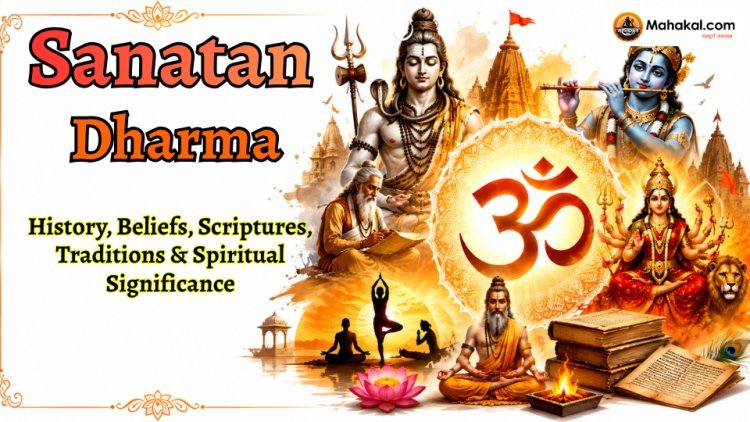
Sanatan Dharma: Meaning, History, Beliefs, Scriptures, Traditions & Spiritual Significance
Sanatan Dharma is one of the world's oldest living spiritual traditions. The word “Sanatan” generally means eternal, timeless or everlasting, while “Dharma” refers not only to religion but also to duty, righteous conduct, moral principles and the way of living in harmony with cosmic order.
Sanatan Dharma is much more than a system of worship. It includes diverse philosophies, spiritual practices, festivals, scriptures, yoga, meditation, devotion, self-discipline and the pursuit of self-realization and Moksha.
What is Sanatan Dharma?
Sanatan Dharma is a broad term used to describe the ancient Indian spiritual and philosophical traditions that developed over thousands of years.
Unlike religions founded by a single historical person, Sanatan Dharma does not have one founder or one specific date of origin.
It encompasses different schools of thought and paths of spiritual practice, including Bhakti, Karma, Jnana and Yoga.
At its heart, Sanatan Dharma encourages people to understand their duties, perform righteous actions, seek knowledge and ultimately explore the deeper nature of the self.
What Does Sanatan Dharma Mean?
The word Sanatan means something that is eternal or everlasting.
The word Dharma has a much broader meaning than simply “religion.” Depending on the context, it can refer to:
- Righteous conduct
- Duty
- Moral responsibility
- Right action
- Spiritual principles
- The natural order of life
Therefore, Sanatan Dharma can be understood as an eternal path of righteous living and spiritual exploration.
How Old is Sanatan Dharma?
There is no single historical date that can be identified as the “beginning” of Sanatan Dharma.
The traditions associated with it developed gradually through ancient Indian civilization.
Some of its earliest surviving textual sources include the Vedas, while later philosophical and religious developments appear in the Upanishads, Ramayana, Mahabharata, Bhagavad Gita and Puranas.
Because these traditions evolved over long periods, describing Sanatan Dharma as having one specific founder or starting year would oversimplify its history.
Important Scriptures of Sanatan Dharma
Sanatan Dharma has a vast collection of sacred and philosophical texts.
The Vedas
The four Vedas are:
- Rig Veda
- Yajur Veda
- Sama Veda
- Atharva Veda
They contain hymns, prayers, rituals and ideas connected with ancient Indian religious traditions.
Upanishads
The Upanishads explore profound questions about:
- Atman
- Brahman
- Consciousness
- Knowledge
- Reality
- Liberation
They form an important foundation of Indian philosophical thought.
Bhagavad Gita
The Bhagavad Gita, part of the Mahabharata, presents a dialogue between Lord Krishna and Arjuna.
It discusses important concepts such as:
- Karma Yoga
- Bhakti Yoga
- Jnana Yoga
- Dharma
- Self-knowledge
- Detachment
Ramayana
The Ramayana tells the story of Lord Rama and explores themes such as duty, devotion, courage, family values and righteousness.
Puranas
The Puranas contain stories and teachings related to various Deities, creation, cosmology, sacred places, traditions and spiritual practices.
Core Beliefs of Sanatan Dharma
Sanatan Dharma contains many philosophical schools, so beliefs can differ between traditions. However, several concepts are widely important.
Dharma
Dharma refers to righteous conduct, duty and responsibility.
Karma
Karma refers to actions and their consequences. The idea encourages individuals to think carefully about their actions and intentions.
Atman
Atman is commonly understood as the inner self or soul, although its interpretation differs across philosophical schools.
Rebirth
Many Hindu traditions believe in rebirth, where the cycle of birth and death continues according to karma.
Moksha
Moksha is understood as liberation from the cycle of birth and death and spiritual realization.
The Four Ashramas
Traditional Hindu philosophy also describes four stages of life:
Brahmacharya
The stage of education, learning and discipline.
Grihastha
The household stage involving family, career and social responsibilities.
Vanaprastha
A gradual movement toward detachment from worldly responsibilities.
Sannyasa
A stage traditionally associated with renunciation and deep spiritual pursuit.
The way these stages were understood and practiced has varied across historical periods and communities.
Gods and Goddesses in Sanatan Dharma
One of the most distinctive features of Sanatan traditions is the diversity of forms through which the Divine is worshipped.
Popular deities include:
- Lord Shiva
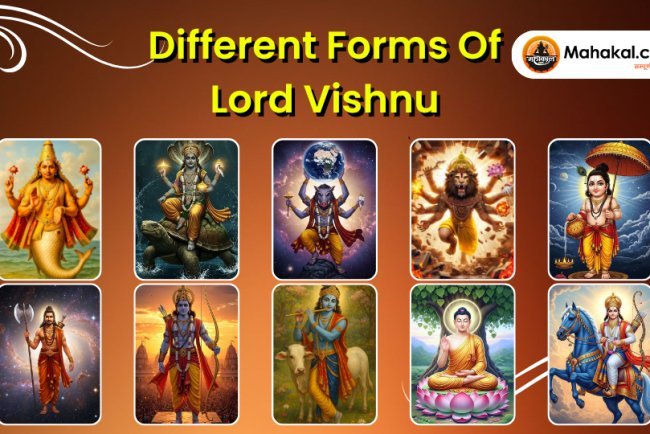
- Lord Vishnu
- Lord Krishna
- Lord Rama
- Lord Ganesha
- Lord Hanuman
- Goddess Durga
- Goddess Lakshmi
- Goddess Saraswati
- Maa Kali
- Lord Surya
Different traditions may place different deities at the center of their worship.
Is There Only One God in Sanatan Dharma?
Sanatan Dharma contains diverse theological and philosophical viewpoints.
Some traditions emphasize one supreme reality, while others worship the Divine through different personal forms.
A devotee may choose a particular Ishta Devata, or chosen form of the Divine, such as Shiva, Vishnu, Krishna, Rama or Devi.
This diversity of worship is one of the defining characteristics of Hindu religious traditions.
Importance of Yoga in Sanatan Dharma
Yoga has a deep philosophical meaning in Indian traditions and is not limited to physical exercises.
Different paths include:
Karma Yoga
The path of selfless action and performing one's duties without excessive attachment to results.
Bhakti Yoga
The path of devotion and love toward the Divine.
Jnana Yoga
The path of knowledge and self-inquiry.
Raja Yoga
A path associated with meditation, concentration and control of the mind.
These paths provide different approaches to spiritual development.
Sanatan Dharma and Festivals
Festivals are an important part of Hindu religious and cultural life.
Major festivals include:
- Diwali
- Holi
- Navratri
- Dussehra
- Janmashtami
- Maha Shivratri
- Ganesh Chaturthi
- Ram Navami
- Raksha Bandhan
- Makar Sankranti
- Kartik Purnima
Each festival has its own mythology, rituals, regional customs and spiritual significance.
Importance of Puja in Sanatan Dharma
Puja is a devotional practice through which devotees express reverence toward the Divine.
Depending on the tradition, worship may include:
- Mantra chanting
- Meditation
- Offering flowers
- Lighting a Diya
- Aarti
- Bhajans
- Prayers
- Fasting
- Temple visits
- Charity
There is no single universal Puja method followed by every Hindu community.
Sanatan Dharma and Nature
Respect for nature is an important theme across many Indian religious traditions.
Rivers, mountains, trees, animals and natural elements have traditionally been given religious and cultural significance.
Examples include reverence for:
- Ganga
- Yamuna
- Tulsi
- Peepal tree
- Cow
- Sun
- Sacred rivers and mountains
These traditions can also encourage a deeper sense of respect for the natural world.
Why is Sanatan Dharma Still Relevant Today?
Modern life can bring stress, competition and constant distractions.
Ideas found within Sanatan philosophical traditions—such as meditation, self-discipline, Karma, Dharma, Yoga, service and self-reflection—continue to influence people around the world.
The teachings encourage individuals to look beyond material success and consider their actions, thoughts, responsibilities and inner growth.
What Can We Learn From Sanatan Dharma?
Sanatan traditions contain many different teachings, but some widely valued life principles include:
- Follow righteousness
- Perform your duties sincerely
- Think about the consequences of your actions
- Seek knowledge
- Practice self-discipline
- Show compassion
- Respect nature
- Serve others
- Control negative tendencies
- Explore your inner self
- Maintain balance in life
Sanatan Dharma: A Way of Life or Religion?
This is a commonly searched question.
Sanatan Dharma is often described as a way of life, particularly because it includes philosophy, ethics, spirituality, family responsibilities, festivals, rituals and daily practices.
At the same time, it also functions as a religious tradition with temples, scriptures, worship practices, festivals and diverse theological beliefs.
Therefore, it is more accurate to recognize Sanatan Dharma as a broad and diverse spiritual-religious tradition, rather than reducing it to a single definition.
Conclusion
Sanatan Dharma is a vast and diverse Indian spiritual tradition centered around ideas such as Dharma, Karma, self-knowledge, spiritual discipline and Moksha.
Its scriptures and traditions offer many different paths—including devotion, knowledge, meditation and selfless action.
Rather than following one single form of worship, Sanatan traditions contain a wide variety of philosophies and practices that have developed across centuries.
What's Your Reaction?