What Is Moksha? Understanding Liberation According to Sanatan Dharma
Explore the true meaning of Moksha in Sanatan Dharma — liberation from the cycle of birth and death. Learn about Atma, Karma, Samsara, the four paths to liberation, teachings of the Upanishads, Bhagavad Gita, and the deeper spiritual purpose of human life. Know complete spiritual details through Mahakal.com
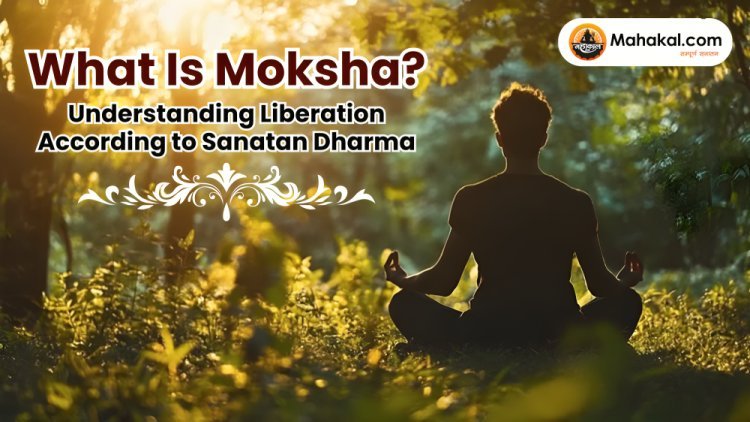
What Is Moksha? Understanding Liberation According to Sanatan Dharma im hindi title
Introduction — The Highest Goal of Human Life
In the vast, eternal ocean of Sanatan Dharma — the oldest living spiritual tradition on Earth — there exists one supreme aspiration that transcends all worldly ambitions: Moksha. It is not merely a religious concept; it is the very reason the human soul takes birth, the destination toward which every sincere seeker ultimately walks.
Across millennia, the great rishis of Bharat sat in deep tapasya along the banks of sacred rivers, not to accumulate wealth or power, but to unlock the secret of existence itself. Their inquiry was singular and profound: Who am I? What is the nature of this Self? And how does the soul return to its original state of freedom?
The answer they discovered — preserved across the Vedas, the Upanishads, the Bhagavad Gita, and countless other sacred texts — forms the foundation of what we call Moksha. This article is a deep, sincere exploration of that answer.
What Does Moksha Mean?
The Sanskrit word Moksha (मोक्ष) is derived from the root muc (मुच्), meaning "to release," "to let go," or "to liberate." It refers to the ultimate liberation of the Atma (आत्मा — the individual soul) from the endless cycle of birth, death, and rebirth known as Samsara (संसार).
Moksha - Liberation from the cycle of rebirth; dissolution of the individual ego into universal consciousness
Mukti - Freedom from suffering and ignorance; often used interchangeably with Moksha across different traditions.
Moksha is also called Mukti (मुक्ति), Nirvana (in Buddhist philosophy), Kaivalya (in Jain and Yoga traditions), and Videha-mukti (liberation after death). While these terms carry nuanced differences, they all point to the same essential truth: the soul's return to its primordial, unconditioned state.
मुक्तिर्हि बाधरायण: परमपुरुषार्थः।"Liberation is, according to Badarayana, the supreme goal of human life."—
Brahma Sutras
At its deepest level, Moksha is the recognition that the individual Atma is not separate from Brahman — the ultimate, infinite, formless consciousness that underlies all of existence. The great declaration of the Upanishads, Aham Brahmasmi (अहं ब्रह्मास्मि — "I am Brahman"), is not a philosophical claim but a lived realization that constitutes Moksha itself.
Moksha is not a place you go after death — it is a state of being you awaken to when the veil of illusion finally falls.
Moksha and the Four Purusharthas
Sanatan Dharma teaches that human life has four essential pursuits, collectively called the Chatur Purushartha (चतुर पुरुषार्थ) — the four aims of existence. Understanding where Moksha fits within this framework illuminates why it is considered the ultimate goal.
Dharma (धर्म) — Righteous LivingThe foundation of all other pursuits; living in alignment with cosmic law, one's duty, and moral truth. Without Dharma, the other pursuits lead to suffering.
Artha (अर्थ) — Wealth & ProsperityThe pursuit of material well-being, security, and worldly success — considered valid and necessary when pursued within the bounds of Dharma.
Kama (काम) — Desire & PleasureThe fulfillment of legitimate desires, love, aesthetic experience, and sensory pleasure — again, sanctified by Dharma and pursued with awareness.
Moksha (मोक्ष) — LiberationThe supreme aim that transcends and encompasses all others. When the soul has experienced the full arc of worldly life, it turns toward the eternal — and seeks freedom from the cycle itself.
The ancient seers did not condemn worldly life. They recognized that Dharma, Artha, and Kama all have their place. But they also understood that no worldly attainment can permanently satisfy the deepest longing of the soul. Ultimately, the Atma seeks to return to its source — and that return is Moksha.
Bandhan — The Cycle of Samsara and Why We Seek Freedom ?
To understand why Moksha matters, one must first understand Bandhan (बंधन — bondage) and the nature of Samsara. According to Sanatan Dharma, the Atma — pure, eternal, and luminous by nature — becomes entangled in the material world through the force of Avidya (अविद्या — ignorance).
This ignorance causes the soul to misidentify itself with the body, the mind, the ego, and all its accumulated impressions — the Samskaras. Driven by this misidentification, the soul generates Karma (action with attachment), which in turn binds it to a continuous cycle of cause and effect, birth and death.
न जायते म्रियते वा कदाचिन्नायं भूत्वा भविता वा न भूयः।
अजो नित्यः शाश्वतोऽयं पुराणो न हन्यते हन्यमाने शरीरे॥
"The soul is never born nor dies at any time. It has not come into being, does not come into being, and will not come into being. It is unborn, eternal, ever-existing, and primeval. It is not slain when the body is slain."— Bhagavad Gita, Chapter 2, Verse 20
The tragedy of Samsara is not suffering itself — it is the forgetting. The Atma, in its pure state, is Sat-Chit-Ananda (सत्-चित्-आनंद): pure existence, pure consciousness, pure bliss. Moksha is nothing but the remembering — the direct recognition of what the soul has always been.
The Four Paths to Moksha
Sanatan Dharma, in its extraordinary wisdom and compassion, does not prescribe a single path to liberation. Recognizing that human beings have different temperaments, capacities, and inclinations, the tradition outlines four principal paths — the Chatur Marga — each suited to a different type of seeker.
Jnana Yoga — The Path of Knowledge
Suited for those with an intellectual and philosophical temperament. Through study of scriptures, deep inquiry (Viveka), and the practice of Neti-Neti ("not this, not this"), the seeker dis-identifies with everything impermanent until only the pure Self remains. Taught most powerfully by Adi Shankaracharya and the Upanishads.
Bhakti Yoga — The Path of Devotion
The path of love, surrender, and devotion to the Divine — whether as Krishna, Shiva, Devi, Rama, or any chosen form of the Absolute. Through prayer, kirtan, seva (selfless service), and total surrender of the ego to God, the individual self dissolves into the Divine. The Bhagavata Purana and the teachings of Mirabai, Tukaram, and Chaitanya Mahaprabhu exemplify this path.
Karma Yoga — The Path of Action
Liberation through selfless action. As Sri Krishna teaches Arjuna in the Bhagavad Gita: act without attachment to fruits, offering every action to the Divine. When action is freed from ego and desire, it generates no new Karma and gradually purifies the being. The Karma yogi finds liberation in the midst of engaged, active life.
Raja Yoga — The Royal Path of Meditation
The systematic science of the mind, codified by Patanjali in the Yoga Sutras as the Ashtanga (eight-limbed) path. Through ethical discipline (Yama-Niyama), physical posture, breath control, sense withdrawal, concentration, meditation, and ultimately Samadhi, the yogi stills the mind completely and realizes the Self beyond all thought.
These four paths are not mutually exclusive. Most sincere seekers naturally integrate elements of all four — knowledge, devotion, selfless action, and meditative practice — as their spiritual life deepens.
Different Schools of Thought on Moksha
The philosophical richness of Sanatan Dharma is reflected in the fact that different schools (Darshanas) offer distinct but complementary understandings of Moksha :
Advaita Vedanta — Non-Dualism
Propounded by Adi Shankaracharya (8th century CE) based on the Upanishads, Advaita (अद्वैत — "not two") holds that the individual Atma and Brahman are ultimately identical. Moksha, in this view, is the direct realization of this non-difference — the dissolution of the illusion of separateness. There is no "you" going to Brahman; the recognition that you were always Brahman is Moksha.
Vishishtadvaita — Qualified Non-Dualism
Taught by Sri Ramanujacharya (11th century), this school holds that the individual soul and Brahman are non-different in essence yet remain distinct in mode. Moksha here is Sayujya — eternal union with the Personal God (Vishnu/Narayana) in blissful relationship, not merging into undifferentiated consciousness.
Dvaita — Dualism
Taught by Sri Madhvacharya (13th century), Dvaita maintains an eternal distinction between the individual soul and Brahman (God). Moksha is the soul dwelling in the eternal presence of Vishnu, experiencing divine bliss — but always remaining a distinct, individual being.
सर्वं खल्विदं ब्रह्म।"All this is, indeed, Brahman."— Chandogya Upanishad 3.14.1
The existence of these diverse schools is a testament to Sanatan Dharma's intellectual depth. The tradition holds that all these paths lead to the same ultimate truth — they simply describe different facets of the same infinite diamond.
What the Scriptures Say About Moksha?
The concept of Moksha is not the invention of any single teacher or age — it runs like a golden thread through the entire body of Sanatan Dharma's sacred literature, spanning thousands of years.
The Upanishads (उपनिषद्) - The philosophical crown of the Vedas, the Upanishads are entirely dedicated to the inquiry into Brahman, Atma, and liberation. The Brihadaranyaka, Chandogya, Kena, Katha, and Mundaka Upanishads, among others, explore every dimension of Moksha with unparalleled depth.
Bhagavad Gita (भगवद्गीता) - Sri Krishna's discourse on the battlefield of Kurukshetra is, at its heart, a manual for Moksha. Chapters 2, 4, 9, and 18 in particular contain some of the most direct and powerful teachings on liberation ever recorded.
Brahma Sutras (ब्रह्म सूत्र) - The systematic aphorisms of Badarayana/Vyasa that logically codify the Upanishadic teachings on Brahman and the path to liberation.
Yoga Sutras of Patanjali (योग सूत्र) - The definitive text on Raja Yoga, outlining the complete practical science for achieving Samadhi and Kaivalya (liberation through the Yoga path).
Vishnu Purana & Bhagavata Purana (भागवत पुराण) - The great devotional scriptures that describe the nature of God, the soul, and liberation through the path of Bhakti in vivid and moving narrative form.
The seeker who reaches Moksha does not escape the world — they discover that the world and the self were never separate from the Divine.
Moksha in the Modern Age
In an era defined by technological acceleration, material abundance, and — paradoxically — a profound crisis of meaning, the relevance of Moksha has never been greater. Modern humanity, despite unparalleled material comfort, is haunted by anxiety, existential emptiness, and a searching hunger for something beyond.
The great sages of recent centuries — Ramakrishna Paramahamsa, Swami Vivekananda, Sri Ramana Maharshi, Sri Aurobindo, and many others — interpreted the wisdom of Moksha for the modern seeker. Their message was consistent: the path to liberation does not require renouncing the world. It requires renouncing the illusion of separation from the Divine, which can happen even in the midst of a fully engaged, active life.
Sri Ramana Maharshi pointed to the simplest of all practices: the inquiry Atma Vichara — "Who am I?" — as the direct path to Moksha. Not elaborate ritual, not years of austerity, but a sincere, persistent turning of awareness back on itself until the questioner dissolves and only the Self remains.
Moksha, understood rightly, is not an escape from responsibility or from love. It is the most radical form of presence — living from the depths of one's being, fully awake, fully free, fully here.
Frequently Asked Questions About Moksha
Is Moksha the same as death or ending consciousness?
No. Moksha is not the extinction of consciousness but its fullest flowering. In Advaita, Moksha is the realization that one's individual consciousness was always the infinite universal consciousness. In Bhakti traditions, it is the soul's eternal, blissful relationship with God. Consciousness does not end — it expands infinitely.
Can Moksha be attained in this lifetime (Jivanmukti)?
Yes. The concept of Jivanmukti (जीवनमुक्ति) — liberation while still living in the body — is central to Advaita Vedanta and several other schools. A Jivanmukta lives in the world, engages in all activities, but is inwardly free from all identification with the ego and all attachment to outcomes. Sri Ramana Maharshi and Ramakrishna Paramahamsa are considered living examples of this state.
Is Moksha only for renunciants and monks?
Absolutely not. The Bhagavad Gita — given on a battlefield to a warrior-king — makes this unmistakably clear. Sri Krishna teaches Arjuna the path to liberation not by asking him to retire to the forest, but by transforming his understanding of action, duty, and the Self. Karma Yoga is specifically designed for those who live fully engaged in worldly life. Moksha is available to every human soul, regardless of their station in life.
What is the difference between Moksha and Nirvana?
Both terms refer to liberation from the cycle of rebirth and the cessation of suffering rooted in ignorance. However, Nirvana (in Buddhist philosophy) emphasizes the extinction of the conditioned self and craving, while Moksha in Sanatan Dharma emphasizes the positive realization of one's true nature as eternal, conscious, and blissful (Sat-Chit-Ananda). The destination is similar; the map and the language differ.
How does Karma relate to Moksha?
Karma is both the mechanism of bondage and the tool of liberation. Unresolved karma — driven by ego and attachment — perpetuates the cycle of Samsara. But karma performed without attachment, as an offering to the Divine (Karma Yoga), purifies the mind and generates no new binding impressions. Liberation comes when all accumulated karma has been exhausted or dissolved through spiritual practice and grace.
तत्त्वमसि।"That thou art." — You are already That which you seek.— Chandogya Upanishad 6.8.7 (One of the Four Mahavakyas)
The search for Moksha is, ultimately, the search for our own deepest nature. Every tradition within Sanatan Dharma agrees on this essential point: the liberation we seek is not somewhere else. It is here. It is now. It is what we are — beneath every layer of conditioning, every thought, every fear, every desire.
The path may take many forms — devotion, knowledge, action, meditation. But the destination is the same for every sincere soul: the recognition of the eternal Self, at rest in its own infinite being, forever free.
ॐ शांति शांति शांतिः
- What is Moksha in Sanatan Dharma?
- How to attain Moksha in Hinduism?
- Meaning of Moksha according to Bhagavad Gita
- Liberation from the cycle of birth and death
- Four paths of Moksha in Hindu philosophy
- Spiritual meaning of Atma and Brahman
Experience Sanatan Dharma at Your Space, Download the Mahakal.com App Today.
What's Your Reaction?