When Will Lord Vishnu Wake Up on Dev Uthani Ekadashi? Know Why Marriage and Auspicious Activities Begin After This Day
Why is Dev Uthani Ekadashi considered the day when Lord Vishnu wakes from Yogic Sleep? Discover its 2026 date, the significance of Chaturmas ending, why weddings and auspicious activities begin and the connection with Tulsi Vivah.
Content Blog
When Will Lord Vishnu Wake Up on Dev Uthani Ekadashi? Know Why Marriage and Auspicious Activities Begin After This Day
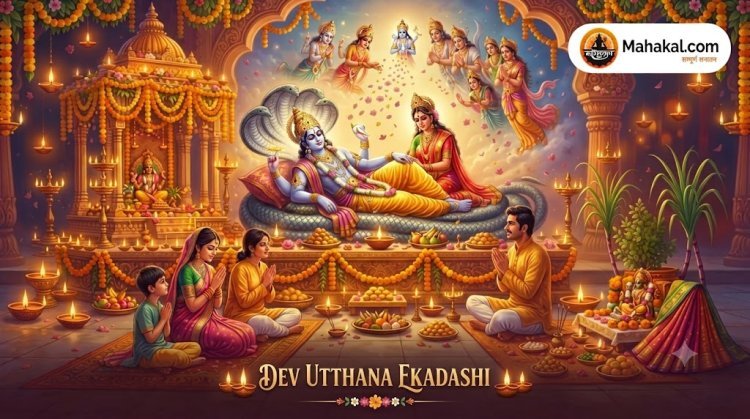
Dev Uthani Ekadashi, also known as Devutthan Ekadashi and Prabodhini Ekadashi, is one of the important Ekadashi observances in the Hindu religious calendar. It is traditionally associated with the awakening of Lord Vishnu from Yogic Sleep and the end of the Chaturmas period.
According to Hindu tradition, Lord Vishnu enters Yogic Sleep on Shayani Ekadashi and awakens on Prabodhini Ekadashi. The day is therefore associated with spiritual renewal, religious observances and the beginning of a period considered suitable for many auspicious activities.
When is Dev Uthani Ekadashi in 2026?
Dev Uthani Ekadashi will be observed on Friday, November 20, 2026. Panchang calculations place the Ekadashi Tithi from approximately 7:15–7:16 AM on November 20 until around 6:31–6:32 AM on November 21.
It is important to understand that the statement “Lord Vishnu will wake up at a particular clock time” is not meant as a literal human-style waking moment. Religiously, Prabodhini Ekadashi itself is regarded as the occasion of Vishnu's awakening.
So why does this day become so important for weddings and other auspicious activities? Let us understand the complete significance.
1. What Is Dev Uthani Ekadashi?
Dev Uthani Ekadashi is observed on the Ekadashi Tithi of the bright fortnight of the Hindu month of Kartik. It is also known as Prabodhini Ekadashi and Devutthan Ekadashi.
The day is dedicated to Lord Vishnu and is associated with worship, fasting, prayer, Naam remembrance and religious observances.
In many traditions, Tulsi Vivah is also performed around this period, further strengthening the connection between this Ekadashi and the beginning of the auspicious season.
2. Why Is Lord Vishnu Said to Sleep for Four Months?
The religious period of Chaturmas is associated with a traditional belief that Lord Vishnu enters Yogic Sleep beginning with Shayani Ekadashi.
This period became closely associated with spiritual discipline, fasting, prayer and religious observance. Dev Uthani Ekadashi marks the traditional end of this period.
Thus, the awakening of Lord Vishnu symbolically represents the transition from one religious phase into another.
3. When Does Lord Vishnu Wake Up?
According to Hindu religious belief, Lord Vishnu awakens on Kartik Shukla Ekadashi, the day celebrated as Dev Uthani or Prabodhini Ekadashi.
In 2026, this falls on November 20.
The exact astronomical timings belong to the Ekadashi Tithi, while the statement that Vishnu “awakens” is a religious and symbolic description of the day.
Therefore, it is more appropriate to say that Lord Vishnu's awakening is celebrated throughout the sacred Ekadashi observance, rather than assigning a literal waking time like that of a human being.
4. What Is the Religious Significance of Vishnu's Awakening?
Lord Vishnu is traditionally worshipped as the Preserver in Hindu thought. His awakening is therefore associated with renewal, protection, dharma and positive beginnings.
Dev Uthani Ekadashi represents an important transition in the religious calendar. It encourages devotees to return to active religious and social observances after the Chaturmas period.
The day can also be seen spiritually as a reminder to awaken one's own awareness, discipline and sense of responsibility.
5. Why Do Weddings Begin After Dev Uthani Ekadashi?
This is one of the most popular questions connected with the festival.
In Hindu tradition, weddings and certain other major auspicious ceremonies are generally avoided during Chaturmas. After Dev Uthani Ekadashi, when the religious period of Vishnu's Yogic Sleep is considered complete, the season for auspicious ceremonies is traditionally regarded as open again.
This is why Dev Uthani Ekadashi is often popularly described as the beginning of the marriage season.
However, this does not mean that every day after Ekadashi is automatically suitable for every ceremony. Weddings and other important rituals are usually scheduled according to the specific Muhurat, Tithi and Panchang.
6. What Does the End of Chaturmas Mean?
Chaturmas is an important religious period associated with spiritual discipline, worship, fasting and restraint.
Dev Uthani Ekadashi marks its traditional conclusion. With this transition, many families begin planning weddings, religious ceremonies and other auspicious events.
The festival therefore represents not only the awakening of Lord Vishnu but also the beginning of a new religious and social phase.
7. What Is the Connection Between Dev Uthani Ekadashi and Tulsi Vivah?
Tulsi Vivah is commonly performed around Dev Uthani Ekadashi. In this ceremony, Goddess Tulsi is symbolically married to Lord Vishnu in the form of Shaligram.
Families decorate the Tulsi plant, worship Shaligram and perform symbolic wedding rituals according to their regional customs.
The connection between Vishnu's awakening and Tulsi Vivah is one reason why the festival period is associated so strongly with auspicious beginnings.
8. What Do Devotees Do on Dev Uthani Ekadashi?
Devotees may follow different customs according to their family and regional traditions.
Worship Lord Vishnu
Devotees begin the day with bathing, prayer and worship of Lord Vishnu. Flowers, lamps, fruits and other traditional offerings may be used.
Observe the Ekadashi Vrat
Many devotees observe an Ekadashi fast according to their physical ability and family tradition.
Practise Naam Simran
Time may be spent chanting divine names, reciting prayers or engaging in spiritual reflection.
Worship Tulsi
The sacred Tulsi plant is worshipped with devotion, and lamps may be lit near it.
Donate
Food, grains, clothing or other useful items may be donated to people in need according to one's capacity.
Plan Auspicious Ceremonies
Families may begin planning weddings and other ceremonies after Dev Uthani Ekadashi, while consulting the appropriate Panchang and Muhurat for the actual event.
9. Can Every Auspicious Activity Be Performed Immediately After Dev Uthani Ekadashi?
The traditional belief is that an auspicious period begins after Dev Uthani Ekadashi, but this does not mean that every day and every time is equally favourable.
Different ceremonies have different Muhurat requirements. Weddings, housewarming ceremonies and important religious rituals are generally scheduled according to the Hindu calendar and local traditions.
Therefore, Dev Uthani Ekadashi should be understood as a traditional beginning of the favourable ceremonial period, while the final date and time should be determined separately.
10. What Is the Spiritual Message of Dev Uthani Ekadashi?
The deeper meaning of Dev Uthani Ekadashi goes far beyond the start of wedding season.
The symbolic awakening of Lord Vishnu can inspire us to awaken our own inner awareness.
Are we living honestly?
Are we fulfilling our responsibilities?
Do we give enough time to prayer and self-reflection?
Are we treating others with kindness and respect?
In this sense, Dev Uthani Ekadashi can become a festival of inner awakening as well.
11. What Positive Resolutions Can We Take on Dev Uthani Ekadashi?
This sacred day can be used to make meaningful personal resolutions.
Commit to honest work.
Strengthen family relationships.
Help people who need support.
Reduce negative habits.
Spend time every day in prayer or spiritual reflection.
Become more responsible toward nature and society.
Such practices transform a religious festival from a one-day celebration into a continuing spiritual discipline.
12. Why Is Dev Uthani Ekadashi So Important?
Dev Uthani Ekadashi brings together several important religious ideas: the awakening of Lord Vishnu, the end of Chaturmas, the beginning of the traditionally auspicious period, Tulsi Vivah and renewed devotion.
That is why it occupies an important place in the Hindu religious calendar.
Its message is also deeply universal: after a period of rest and inward discipline, a new beginning is possible.
Conclusion:
Why Do Auspicious Activities Begin After Lord Vishnu Awakens?
Dev Uthani Ekadashi is an important Hindu religious observance associated with the awakening of Lord Vishnu from Yogic Sleep and the traditional conclusion of Chaturmas. Because of this transition, the period after Dev Uthani Ekadashi is traditionally associated with the beginning of weddings and other auspicious ceremonies.
In 2026, Dev Uthani Ekadashi falls on November 20, making it an important date for devotees observing the festival this year.
The deeper message of Dev Uthani Ekadashi is not simply that “auspicious work can now begin.” It is also an invitation to wake up spiritually, leave behind negativity and begin a new phase of life with devotion, discipline, responsibility and positive intentions.
The awakening of Lord Vishnu is a sacred religious symbol—and its greatest life lesson is to awaken ourselves toward truth, faith, good actions and a meaningful new beginning.
What's Your Reaction?