Why Does Lord Vishnu Sleep on Sheshnag in the Cosmic Ocean? The Mystery of Yog Nidra and the Origin of Creation
Discover the fascinating mystery of Lord Vishnu's Yog Nidra in the Kshirsagar, the significance of Sheshnag, the divine lotus emerging from his navel and the mythological story of Brahma's birth and creation of the universe.
The Divine Mystery of Lord Vishnu's Yog Nidra
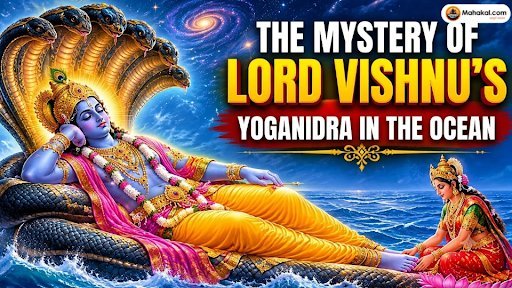
In Hinduism, Lord Vishnu is worshipped as the preserver of the universe. Many devotees are familiar with the divine image of Lord Vishnu resting on the serpent Sheshnag in the cosmic ocean, known as Kshirsagar.
In this divine depiction, Goddess Lakshmi sits near his feet, while a lotus emerges from his navel, upon which Lord Brahma is seated.
However, several fascinating questions arise from this image. Why does Lord Vishnu rest in the cosmic ocean? Why is he shown in a state of Yog Nidra? What is the significance of the lotus emerging from his navel? And how did Lord Brahma originate from that lotus?
This sacred representation is more than a religious image. It symbolically explains the origin of creation, the continuity of time, cosmic consciousness and the balance of the universe.
Let us explore the fascinating mythological story and spiritual significance behind Lord Vishnu's Yog Nidra.
1. What Is Kshirsagar and Why Does Lord Vishnu Reside There?
According to Hindu mythology, Kshirsagar is a divine cosmic ocean, also known as the Ocean of Milk. Lord Vishnu is believed to reside in this ocean, resting upon the infinite serpent Sheshnag.
Kshirsagar is not merely described as a physical ocean. It is also interpreted as a symbol of purity, peace and infinite cosmic existence.
Its important symbolic elements include:
-
Kshirsagar: Represents purity, peace and infinite consciousness.
-
Lord Vishnu: Symbolises preservation and universal balance.
-
Sheshnag: Represents eternity and the continuity of time.
-
Goddess Lakshmi: Symbolises wealth, prosperity and abundance.
Together, these elements represent the divine order and balance of the universe.
2. Why Does Lord Vishnu Remain in Yog Nidra?
Yog Nidra is one of the most fascinating aspects of Lord Vishnu's divine form.
Unlike ordinary sleep, Yog Nidra is associated with a deep spiritual state of awareness and divine consciousness.
According to Hindu traditions, Lord Vishnu's Yog Nidra has two important symbolic interpretations.
Preservation of the Universe: Lord Vishnu's Yog Nidra represents the divine state associated with maintaining the cosmic order and balance.
The Period of Cosmic Rest: During the dissolution of the universe, all creation is believed to become absorbed into the supreme divine reality. A new cycle of creation begins when the appropriate cosmic time arrives.
Therefore, Lord Vishnu's Yog Nidra is not understood as ordinary sleep but as a representation of infinite divine power and cosmic consciousness.
3. How Did the Lotus Emerge from Lord Vishnu's Navel?
One of the most mysterious elements in Lord Vishnu's traditional depiction is the lotus emerging from his navel.
According to Hindu mythology, when the time for creation arrived, a divine lotus emerged from Lord Vishnu's navel. Lord Brahma appeared seated upon this lotus.
When Brahma opened his eyes, he found himself surrounded by an unfamiliar cosmic existence. He wondered about his origin and the source of the universe.
He attempted to discover the source of the lotus through its stem but could not find its end. Eventually, he turned towards meditation and spiritual contemplation.
Through divine grace, Brahma received the knowledge required to perform the task of creation. He then began creating the universe.
Spiritual Significance of the Lotus:
-
Lord Vishnu represents the supreme sustaining consciousness.
-
The lotus symbolises the beginning of creation.
-
Lord Brahma represents the creative power of the universe.
This story symbolically explains the relationship between divine consciousness and the process of creation.
4. Why Does Lord Vishnu Rest on Sheshnag?
The serpent upon whom Lord Vishnu rests is known as Sheshnag or Ananta Shesha.
According to Hindu mythology, Sheshnag has multiple hoods and represents eternity and infinite time.
The word 'Shesha' carries a deep symbolic meaning. It refers to that which remains even after everything else has disappeared.
Sheshnag is therefore associated with the eternal foundation of existence.
Lord Vishnu resting upon Sheshnag represents the idea that the supreme divine reality exists beyond the limitations of time and worldly changes.
5. Why Does Goddess Lakshmi Sit Near Lord Vishnu's Feet?
In traditional depictions, Goddess Lakshmi is shown sitting near Lord Vishnu's feet and serving him.
Goddess Lakshmi is worshipped as the deity of wealth, prosperity, abundance and good fortune, while Lord Vishnu represents the preservation of the universe.
This divine representation carries an important spiritual message: wealth and prosperity should always be guided by righteousness, wisdom and responsibility.
The association of Goddess Lakshmi with Lord Vishnu symbolises the importance of using wealth for good purposes, maintaining harmony and supporting the welfare of others.
6. Lord Vishnu's Yog Nidra and the Tradition of Chaturmas
Chaturmas is an important religious period in Hinduism that begins on Devshayani Ekadashi and concludes on Devutthana Ekadashi.
According to religious belief, Lord Vishnu enters Yog Nidra on Devshayani Ekadashi and awakens on Devutthana Ekadashi.
During this period, devotees observe various spiritual practices.
Some common traditions include:
-
Worshipping Lord Vishnu.
-
Observing Ekadashi fasts.
-
Reading the Bhagavad Gita and other sacred scriptures.
-
Practising meditation and spiritual discipline.
-
Following a sattvic lifestyle.
This tradition is closely associated with Lord Vishnu's Yog Nidra and encourages devotees to focus on devotion and self-discipline.
7. The Roles of Brahma, Vishnu and Shiva in Creation
Hinduism describes the three divine aspects of Brahma, Vishnu and Shiva as the representatives of creation, preservation and dissolution.
Lord Brahma – The Creator
Lord Brahma is regarded as the creator of the universe. According to mythology, he appeared on the lotus emerging from Lord Vishnu's navel.
Lord Vishnu – The Preserver
Lord Vishnu maintains the balance of the universe and protects dharma. His various incarnations are associated with restoring righteousness.
Lord Shiva – The Destroyer and Transformer
Lord Shiva represents dissolution and transformation. Destruction is not simply an ending; it also symbolises the beginning of a new cycle of creation.
Together, the Trimurti represents the continuous cycle of creation, preservation and transformation.
8. Life Lessons from Lord Vishnu's Yog Nidra
The image of Lord Vishnu resting in Yog Nidra offers several valuable lessons for everyday life.
Peace Is a Form of Strength: Remaining calm during difficult situations can help people make wiser decisions.
Patience Is Essential: Lord Vishnu's peaceful posture symbolises the importance of patience and stability.
Maintain Balance: Just as the universe operates through balance, human life also requires harmony between work, family and spirituality.
Avoid Ego: The story of Lord Brahma reminds us that knowledge requires humility, curiosity and dedication.
Accept Change: Creation, preservation and dissolution represent the natural cycle of existence. Similarly, change is an essential part of human life.
Conclusion: The Cosmic Message Hidden in Lord Vishnu's Yog Nidra
Lord Vishnu resting on Sheshnag in the cosmic ocean is one of the most meaningful spiritual representations in Hindu mythology.
The lotus emerging from his navel symbolises creation, Lord Brahma represents the creative force, and Sheshnag represents eternity.
Together, these elements illustrate the divine cycle of creation, preservation and transformation.
The spiritual message of Lord Vishnu's Yog Nidra reminds us that true strength is not only about taking action but also about maintaining peace, patience, wisdom and balance.
Through this divine symbolism, Hindu mythology offers a deeper understanding of the universe and the eternal nature of existence.
What's Your Reaction?