The 10 Avatars of Lord Vishnu: Stories, Significance and the Divine Mystery of Dashavatara
Discover the fascinating stories of the 10 avatars of Lord Vishnu, including Matsya, Kurma, Varaha, Narasimha, Vamana, Parashurama, Rama, Krishna, Buddha and Kalki.
What Is the Mystery Behind the 10 Avatars of Lord Vishnu?
In Hinduism, Lord Vishnu is worshipped as the preserver and protector of the universe. According to Hindu scriptures, whenever evil increases and righteousness declines, Lord Vishnu incarnates in different forms to restore the balance between good and evil.
The Bhagavad Gita expresses this divine principle through the famous verse:
"Yada Yada Hi Dharmasya Glanir Bhavati Bharata..."
It means that whenever righteousness declines and unrighteousness rises, the Divine manifests to restore Dharma.
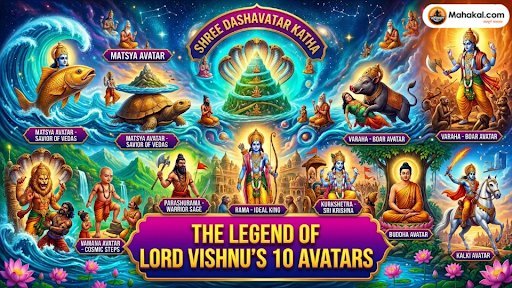
The ten principal incarnations of Lord Vishnu are collectively known as Dashavatara. Each incarnation has a unique purpose and carries important spiritual lessons about truth, courage, devotion, compassion and righteousness.
Let us explore the fascinating stories and religious significance of all ten avatars of Lord Vishnu.
1. Matsya Avatar – The Divine Fish Who Saved Creation
Story:
Matsya is traditionally regarded as the first avatar of Lord Vishnu.
According to Hindu mythology, King Satyavrata once found a small fish while performing his daily rituals. The fish requested protection, and the king placed it in his water vessel.
However, the fish continued to grow larger until even the rivers and oceans could not contain it.
The fish then revealed its divine identity as Lord Vishnu and warned the king about an approaching great flood.
Lord Vishnu instructed the king to prepare a large boat to protect the sages, living beings and sacred knowledge.
When the flood arrived, Lord Vishnu appeared as Matsya and guided the boat to safety.
Religious Significance:
Matsya Avatar represents the protection of life, knowledge and creation. It teaches that divine protection can appear in any form.
2. Kurma Avatar – The Divine Tortoise Who Supported Mount Mandara
Story:
According to Hindu mythology, the gods once lost their strength and sought Lord Vishnu's guidance.
He advised them to perform Samudra Manthan, the churning of the cosmic ocean, with the demons.
Mount Mandara was used as the churning rod, while the serpent Vasuki served as the rope.
However, the mountain began sinking into the ocean.
To solve this problem, Lord Vishnu assumed the form of a giant tortoise called Kurma and supported the mountain on his back.
The churning eventually produced fourteen precious treasures, including Goddess Lakshmi, Airavata and the divine nectar of immortality.
Religious Significance:
Kurma Avatar symbolizes patience, stability, strength and cooperation. It teaches that great achievements require a strong foundation and determination.
3. Varaha Avatar – The Divine Boar Who Rescued Mother Earth
Story:
According to mythology, a powerful demon named Hiranyaksha dragged the Earth into the depths of the cosmic waters.
The balance of creation was disturbed, and the gods prayed to Lord Vishnu for help.
Lord Vishnu appeared in the form of a mighty boar known as Varaha.
He entered the cosmic waters, located the Earth and lifted it on his powerful tusks.
A fierce battle followed between Varaha and Hiranyaksha, during which Lord Vishnu defeated the demon and restored the Earth to its rightful position.
Religious Significance:
Varaha Avatar represents the protection of nature, preservation of the Earth and victory over evil. It reminds humanity of the importance of protecting the natural world.
4. Narasimha Avatar – The Divine Protector of Prahlada
Story:
Hiranyakashipu was a powerful demon king who received a special boon from Lord Brahma.
The boon made him extremely difficult to kill. He could not be killed by a human or animal, during day or night, inside or outside, or by conventional weapons.
He became arrogant and demanded that everyone worship him.
However, his son Prahlada remained a devoted follower of Lord Vishnu.
Despite repeated attempts to change his beliefs, Prahlada never abandoned his devotion.
One day, Hiranyakashipu angrily asked whether Vishnu existed inside a palace pillar.
Prahlada replied that God was present everywhere.
Suddenly, Lord Vishnu emerged from the pillar in the extraordinary form of Narasimha, half-man and half-lion.
He defeated Hiranyakashipu at twilight, on the threshold of the palace, using his claws.
Religious Significance:
Narasimha Avatar symbolizes divine protection, unwavering faith and the destruction of arrogance. It teaches that true devotion cannot be defeated by tyranny.
5. Vamana Avatar – The Divine Dwarf Who Measured the Three Worlds
Story:
King Mahabali was a powerful and generous ruler who gained control over the three worlds.
The gods approached Lord Vishnu for help, and he appeared as a young Brahmin dwarf named Vamana.
During a religious sacrifice performed by King Bali, Vamana requested only three steps of land.
King Bali happily accepted the request.
Vamana then transformed into a gigantic cosmic form known as Trivikrama.
With his first step, he covered the Earth. With the second, he covered the heavens.
There was no space left for the third step.
King Bali offered his own head, demonstrating his generosity and commitment to his promise.
Lord Vishnu blessed him and granted him authority over the realm of Sutala.
Religious Significance:
Vamana Avatar teaches humility, generosity, commitment and the importance of keeping one's promises.
6. Parashurama Avatar – The Warrior Who Fought Injustice
Story:
Parashurama is traditionally considered the sixth avatar of Lord Vishnu.
He was born to Sage Jamadagni and Mother Renuka. His original name was Rama, but he became known as Parashurama after receiving the divine axe, or Parashu, from Lord Shiva.
According to mythology, several rulers had become arrogant and were misusing their power.
One such ruler was Kartavirya Arjuna, also known as Sahasrabahu Arjuna.
After a conflict involving Sage Jamadagni's hermitage and the sacred cow Kamadhenu, Parashurama fought against oppressive rulers.
The Puranic traditions describe his campaigns against unjust Kshatriya rulers.
Religious Significance:
Parashurama Avatar represents courage, discipline, justice and the protection of righteousness. It teaches that power should be used to protect Dharma rather than oppress others.
7. Lord Rama Avatar – The Ideal of Dharma and Righteous Living
Story:
Lord Vishnu incarnated as Lord Rama during the Treta Yuga in the royal family of Ayodhya.
He was the son of King Dasharatha and became known as Maryada Purushottam, the ideal man who upheld righteousness and moral values.
To honour his father's promise, Rama accepted fourteen years of exile.
During the exile, Ravana abducted Goddess Sita.
With the help of Hanuman, Sugriva and the Vanara army, Lord Rama marched towards Lanka and defeated Ravana.
His victory marked the triumph of Dharma over Adharma.
Religious Significance:
Lord Rama represents truth, sacrifice, duty, discipline and ideal leadership. His life inspires people to follow righteousness even during difficult circumstances.
8. Lord Krishna Avatar – The Teacher of Love, Wisdom and Karma Yoga
Story:
Lord Vishnu appeared as Lord Krishna during the Dwapara Yuga in Mathura as the son of Devaki and Vasudeva.
His birth took place during the oppressive rule of King Kansa.
To protect the newborn child, Vasudeva carried Krishna to Gokul, where he was raised by Nanda Baba and Mother Yashoda.
During his childhood, Krishna defeated several demons and protected the people of Vrindavan.
As he grew older, he defeated Kansa and helped restore righteousness.
During the Mahabharata war, Lord Krishna guided Arjuna and delivered the divine teachings of the Bhagavad Gita.
He explained the importance of Karma Yoga, devotion, knowledge and performing one's duties without attachment to results.
Religious Significance:
Krishna Avatar represents divine love, wisdom, friendship, devotion and righteous action. His teachings continue to guide millions of people around the world.
9. Buddha Avatar – The Messenger of Compassion and Non-Violence
Story:
In several widely followed Dashavatara traditions, Gautama Buddha is regarded as the ninth avatar of Lord Vishnu. Some traditions identify Balarama instead.
Gautama Buddha was born as Prince Siddhartha near Lumbini.
After witnessing old age, illness, suffering and death, he left his royal life in search of the truth.
Following years of spiritual practice and meditation, he attained enlightenment under the Bodhi tree at Bodh Gaya.
He became known as the Buddha and taught the principles of compassion, non-violence, mindfulness and the Middle Path.
Religious Significance:
Buddha Avatar represents peace, compassion, wisdom and self-discipline. His teachings encourage people to overcome ignorance and follow a path of kindness.
10. Kalki Avatar – The Future Incarnation Who Will Restore Dharma
Story:
Kalki is traditionally described as the tenth and future avatar of Lord Vishnu.
According to Hindu scriptures, when evil, injustice and unrighteousness reach their highest level during Kali Yuga, Lord Vishnu will appear as Kalki.
The Puranas describe his birth in Shambhala to a Brahmin named Vishnuyasha.
He is traditionally depicted riding a white horse and carrying a sword.
His divine mission will be to destroy Adharma and establish righteousness once again.
Religious Significance:
Kalki Avatar symbolizes hope, justice and the ultimate victory of truth over evil. It reminds devotees that righteousness will ultimately prevail.
What Can We Learn from the Ten Avatars of Lord Vishnu?
Each avatar of Lord Vishnu carries a meaningful lesson for human life.
-
Matsya Avatar: Protect knowledge and life.
-
Kurma Avatar: Develop patience and stability.
-
Varaha Avatar: Protect the Earth and nature.
-
Narasimha Avatar: Stand against arrogance and injustice.
-
Vamana Avatar: Practice humility and generosity.
-
Parashurama Avatar: Fight against injustice.
-
Rama Avatar: Follow truth, duty and discipline.
-
Krishna Avatar: Embrace love, wisdom and Karma Yoga.
-
Buddha Avatar: Practice compassion and non-violence.
-
Kalki Avatar: Believe in the ultimate victory of righteousness.
Is There a Connection Between Dashavatara and the Evolution of Life?
Some modern interpreters have drawn symbolic comparisons between the sequence of Vishnu's ten avatars and the development of life.
For example, Matsya is associated with aquatic life, Kurma with creatures connected to water and land, and Varaha with terrestrial animals.
Narasimha is sometimes interpreted symbolically as a transition between animal and human forms.
Later avatars are associated with human society, warriors, ideal leadership and spiritual wisdom.
However, this is a modern symbolic interpretation rather than a scientific explanation or an established original meaning of the religious tradition.
Conclusion
The ten avatars of Lord Vishnu represent the eternal message of protecting Dharma and restoring balance whenever evil threatens the world.
From Matsya, who protects creation, to Kalki, who is expected to restore righteousness in the future, every avatar carries a unique spiritual lesson.
These divine stories inspire humanity to follow truth, justice, compassion, courage and devotion.
The greatest message of Dashavatara is that righteousness and truth ultimately triumph over evil.
Jai Shri Hari Vishnu!
What's Your Reaction?