Why Is Maa Kushmanda Called the Creator of the Universe? Know the Hidden Religious Belief Behind Her Divine Smile
Why is Maa Kushmanda worshipped on the fourth day of Navratri and called the creator of the universe? Know her divine form, religious significance, worship, story, and spiritual message.
CONTENT BLOG:
Why Is Maa Kushmanda Called the Creator of the Universe?
Navratri is one of the most important festivals dedicated to the worship of Goddess Durga and her nine divine forms. Among these nine forms, Maa Kushmanda is worshipped as the fourth form of Goddess Durga.
According to popular Hindu religious beliefs, Maa Kushmanda is associated with the creation of the universe, divine energy, light, and life-giving power. She is therefore revered as a divine manifestation of Adishakti, the primordial cosmic energy.
One of the most popular religious beliefs says that when darkness prevailed everywhere and there was no visible sign of creation, Maa Kushmanda created the universe through her divine smile. This is why she is traditionally associated with the origin of the cosmic creation.
What Does the Name Maa Kushmanda Mean?
The name Kushmanda is considered spiritually significant. According to traditional beliefs, the Goddess created cosmic energy and light through her gentle divine smile.
Her name and form are therefore associated with the power that transforms darkness into light and brings energy and life into existence.
Maa Kushmanda is also described as a radiant and powerful form of the Goddess whose divine energy represents the life-giving force of the universe.
Why Is Maa Kushmanda Called the Creator of the Universe?
According to popular religious tradition, the universe was surrounded by darkness before creation. Maa Kushmanda manifested her divine energy and, through her cosmic smile, initiated the process of creation.
Because of this belief, Maa Kushmanda is popularly regarded as the Creator of the Universe.
This religious story also carries a deeper spiritual message: light represents positive energy, consciousness, hope, and life, while darkness represents ignorance and negativity.
Why Is Maa Kushmanda Worshipped on the Fourth Day of Navratri?
Maa Kushmanda is worshipped on the fourth day of Navratri. Devotees pray to her for positive energy, prosperity, good health, courage, and peace.
According to traditional beliefs, worshipping Maa Kushmanda with devotion helps devotees develop inner strength and remain positive during difficult situations.
Divine Form of Maa Kushmanda
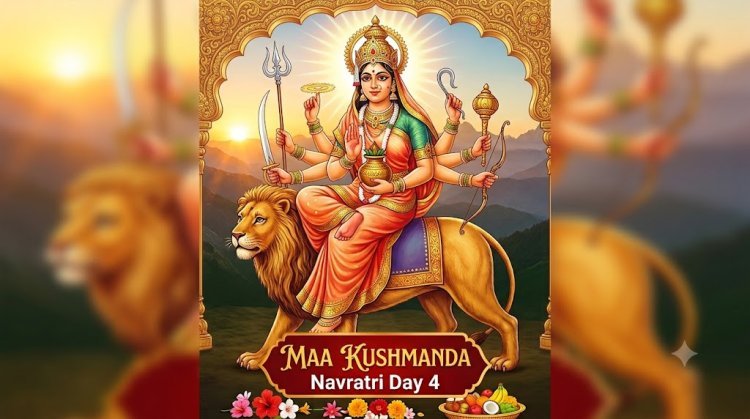
Maa Kushmanda is traditionally depicted as a radiant eight-armed Goddess. Different divine objects and weapons are shown in her hands according to traditional representations.
Her vehicle is considered to be a lion. The lion represents courage, strength, confidence, and fearlessness.
Her divine form reminds devotees to face challenges with courage and maintain faith and positivity in life.
Connection Between Maa Kushmanda and the Sun
Maa Kushmanda is also traditionally associated with the Sun and divine cosmic energy. Religious beliefs describe her as possessing immense radiance and power.
The Sun represents light, consciousness, energy, and life. Therefore, the association of Maa Kushmanda with the Sun reflects her identity as a powerful source of divine energy and illumination.
Religious Significance of Worshipping Maa Kushmanda
Devotees consider the worship of Maa Kushmanda especially meaningful during Navratri. With faith and devotion, people pray to the Goddess for peace, prosperity, health, success, and protection from negativity.
Her worship is also viewed as a way of expressing gratitude toward the divine cosmic energy that sustains life.
What Offering Is Made to Maa Kushmanda?
According to a popular tradition, Malpua is offered to Maa Kushmanda on the fourth day of Navratri.
Devotees offer food, fruits, flowers, incense, lamps, and other items according to their family traditions and personal faith. In devotional practice, sincerity and devotion are considered more important than elaborate rituals.
How to Worship Maa Kushmanda?
On the fourth day of Navratri, devotees traditionally begin their worship after taking a bath and wearing clean clothes. The place of worship is cleaned, and an image or idol of Maa Kushmanda is placed respectfully.
A lamp is lit, followed by prayers and meditation on the Goddess. Flowers, fruits, sacred offerings, and bhog are offered according to tradition. Devotees may also recite the Goddess's story, prayers, or mantra and conclude the worship with Aarti.
Spiritual Message of Maa Kushmanda
The story of Maa Kushmanda gives a powerful spiritual message: light and positive energy have the power to overcome darkness.
When a person experiences fear, disappointment, confusion, or negativity, the symbolism of Maa Kushmanda inspires them to awaken their inner strength and maintain hope.
Her divine smile can therefore be understood as a symbol of creation, positivity, consciousness, and the beginning of a new journey.
Conclusion
Maa Kushmanda is worshipped as the fourth form of Goddess Durga during Navratri. According to popular Hindu religious beliefs, she is associated with the creation of the universe and the emergence of cosmic light and energy.
The belief that Maa Kushmanda created the universe through her divine smile gives her a unique place in Navratri worship. Her form represents cosmic energy, light, courage, positivity, and the power of creation.
For devotees, the worship of Maa Kushmanda is not only a religious tradition but also a reminder to bring light into life, overcome negativity, and awaken the divine strength within.
What's Your Reaction?